If a doctor or audiologist has recommended a PTA test, or if you have simply noticed you are asking people to repeat themselves more often, you are probably looking for two things: a plain explanation of what this test actually involves, and a realistic sense of what it costs in Islamabad. This guide covers both, along with what your results actually mean once you have them in hand.
What Is a PTA Test
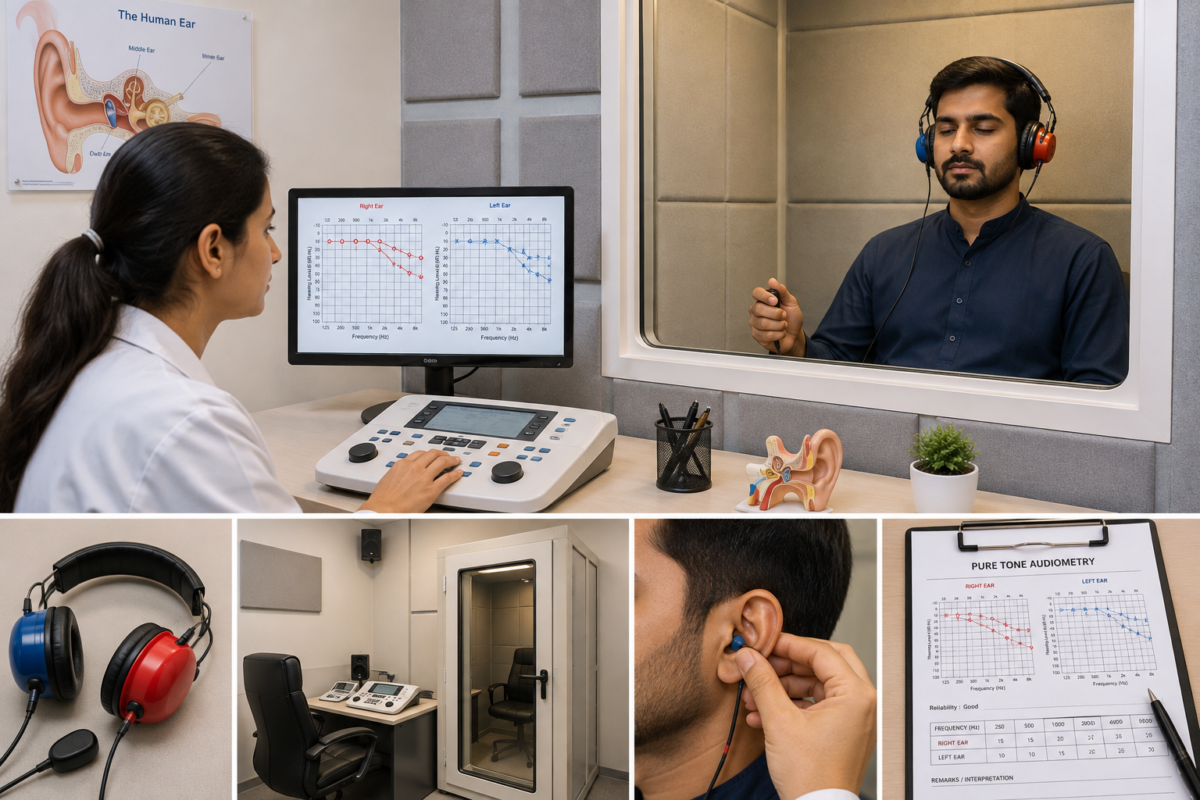
PTA stands for Pure Tone Audiometry, and it is the standard first test used almost everywhere in the world to measure hearing sensitivity. Rather than a general impression of whether you “hear well” or not, PTA measures the exact quietest sound you can detect at a range of specific pitches, from low frequencies around 250 Hz up to high frequencies around 8000 Hz. The result is plotted on a chart called an audiogram, which shows an audiologist precisely how much hearing loss you have, at which pitches, and in which ear.
PTA is considered the reference standard hearing test globally. According to the National Institute on Deafness and Other Communication Disorders, pure tone testing is the most common type of hearing evaluation used to find the quietest sounds a person can hear at different pitches, and it forms the basis for almost every hearing related decision that follows, including whether hearing aids are needed and how they should be programmed.
Why the Test Uses Two Types of Sound Conduction
A full PTA test typically measures hearing in two ways, and understanding the difference explains a lot about what your results will show.
Air conduction testing measures how sound travels through the ear canal, eardrum, and middle ear bones before reaching the inner ear. This is tested using headphones or insert earphones and reflects your overall hearing ability through the entire hearing pathway.
Bone conduction testing measures how sound travels directly to the inner ear through vibration, bypassing the outer and middle ear entirely. This is tested using a small vibrating device placed behind the ear on the mastoid bone.
Comparing the results of both tests is what allows an audiologist to determine the type of hearing loss you have, not just how much of it there is. If air conduction results are worse than bone conduction results, that typically points to a conductive problem, something blocking or restricting sound in the outer or middle ear, such as wax buildup, fluid, or an eardrum issue. If both air and bone conduction results are similarly reduced, that typically points to a sensorineural issue, meaning the inner ear or hearing nerve itself is affected. This distinction matters enormously for treatment, since a conductive problem is often medically treatable, while a sensorineural loss is usually managed with hearing aids.
At IHC, this combined air and bone conduction procedure is also listed separately as Audiometry (AC, BC) on our services page, since it is the specific clinical procedure that produces your PTA results.
Who Actually Needs a PTA Test
A PTA test is appropriate for a wide range of situations, not just for people who suspect significant hearing loss:
Anyone noticing early signs of hearing difficulty, such as frequently asking people to repeat themselves, turning the television volume higher than others prefer, or struggling to follow conversations in noisy places. Our guide on 10 early signs of hearing loss you should never ignore covers these signals in more detail.
Adults over 40, since age related hearing decline is gradual and often goes unnoticed until it has progressed. We cover this specifically in why hearing tests are essential for adults over 40.
People regularly exposed to loud environments, including factory work, construction, traffic noise, or frequent headphone use at high volume, since noise exposure is one of the most common preventable causes of hearing loss worldwide.
Anyone being fitted for hearing aids, since PTA results are what an audiologist uses to determine the correct amplification level for your specific hearing loss, at each frequency, in each ear.
Anyone monitoring an existing hearing condition, since repeat PTA testing over time shows whether hearing has stayed stable, improved, or declined.
How the PTA Test Actually Works
The process itself is simple, painless, and generally takes well under an hour for both ears.
1. You enter a quiet, sound treated room. This controlled environment ensures that background noise does not interfere with your results, since PTA measures extremely quiet sound thresholds.
2. Headphones or insert earphones are placed on or in your ears. Each ear is tested separately, one at a time, so results are ear specific rather than a combined impression.
3. Tones are played at different pitches and volumes. You will hear a series of beeping or steady tones, starting at a level you can clearly hear and gradually decreasing in volume until you can no longer detect it.
4. You respond each time you hear a tone, typically by raising your hand or pressing a button. Your responses at each pitch determine your hearing threshold, the quietest level at which you can reliably detect sound at that specific frequency.
5. The bone conduction portion follows, using a small device placed behind your ear rather than headphones, to test how sound travels directly through bone to the inner ear.
6. Your results are plotted on an audiogram, a graph your audiologist will walk you through, showing your hearing thresholds across the full frequency range for each ear.
What Your PTA Results Actually Mean
Once your audiogram is complete, your audiologist will explain where your results fall relative to standard hearing categories. According to the World Health Organization’s fact sheet on deafness and hearing loss, disabling hearing loss is generally defined as hearing loss greater than 35 decibels in the better hearing ear for adults, with categories ranging from normal hearing through mild, moderate, severe, and profound hearing loss depending on the degree of threshold shift measured.
What matters most is not memorizing these categories yourself, but understanding that your specific results, at your specific frequencies, determine what happens next, whether that is simply monitoring, medical referral for a treatable conductive issue, or moving forward with hearing aid fitting.
PTA Test vs Other Hearing Tests at IHC
It is common to see several different test names listed and wonder which one you actually need. Here is how PTA compares to some of the other tests we offer:
PTA vs BERA Test. PTA is a behavioral test, meaning it requires you to actively respond when you hear a tone, which makes it suitable for cooperative adults and older children. BERA (Brainstem Evoked Response Audiometry) is an objective test that does not require a behavioral response, which makes it the appropriate choice for infants, young children, or anyone unable to reliably participate in a behavioral test. Our BERA test guide covers this test and its cost in detail if a BERA has been recommended instead.
PTA vs Tympanometry. Tympanometry does not measure hearing sensitivity at all. It measures how well your eardrum and middle ear are functioning mechanically, which helps identify issues like fluid buildup or eardrum stiffness that PTA alone would not fully explain.
PTA vs Otoacoustic Emissions (OAE). OAE testing checks whether the inner ear’s sensory cells are functioning by measuring a faint sound the ear naturally produces in response to stimulation. It is commonly used for newborn screening and does not require a behavioral response, but it does not provide the detailed, frequency specific threshold information that PTA does for older children and adults.
In many cases, your audiologist will recommend PTA alongside one or more of these tests for a complete picture, rather than PTA alone.
What Affects the Cost of a PTA Test in Pakistan
PTA test pricing varies based on a few practical factors, which is why it is worth understanding what you are actually paying for rather than comparing a single number across providers:
Single test versus a full diagnostic battery. A standalone PTA test is priced differently than a combined package that includes PTA alongside tympanometry or an audiologist consultation to interpret results and recommend next steps.
Air conduction only versus air and bone conduction. A complete PTA test measuring both air and bone conduction takes longer and provides more diagnostic information than an air conduction only screening, which can affect pricing.
Branch location. IHC operates across multiple cities in Pakistan, including Islamabad, Rawalpindi, Peshawar, Faisalabad, Multan, Karachi, Sargodha, and several others, and pricing can vary slightly by location.
Whether the test is a standalone visit or part of a hearing aid fitting process. PTA testing conducted as part of a hearing aid evaluation is sometimes bundled into the overall service rather than charged separately.
For the most accurate, current pricing at your nearest branch, it is best to contact IHC directly, since published estimates can go out of date while your actual clinic pricing reflects real time costs.
What to Expect at Your Appointment
Before the test itself, your audiologist will typically ask about your hearing history, any noise exposure, medications, or family history relevant to hearing loss. This context helps interpret your results more accurately once testing is complete. After the test, you will review your audiogram together, and if any follow up is needed, whether that is a medical referral, a repeat test, or moving toward hearing aid options, your audiologist will walk you through it directly. You can review the full range of tests offered at our hearing test page before booking.