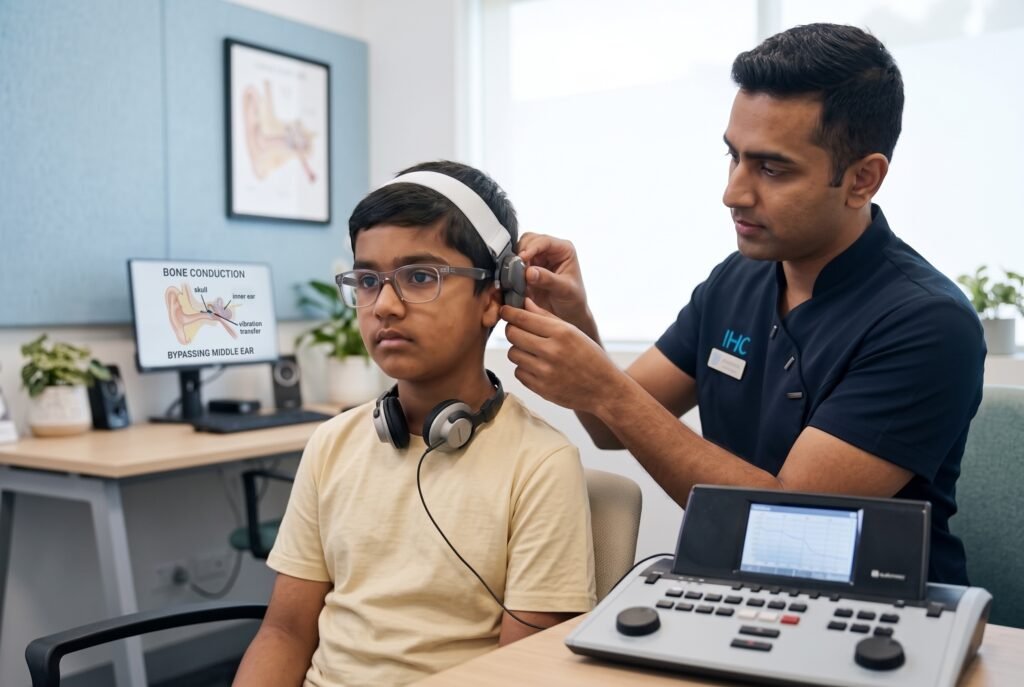
Bone conduction testing helps our audiologists find out exactly where a hearing problem originates, whether it sits in the inner ear or somewhere earlier along the hearing pathway. This means patients can move straight into the right treatment plan without unnecessary guesswork.
Bone conduction is one half of a complete hearing assessment, paired with air conduction testing to give a full picture of a patient’s hearing health. Instead of playing sound through headphones into the ear canal, a small vibrating device is placed behind the ear on the mastoid bone. This sends sound waves directly to the inner ear, bypassing the outer and middle ear entirely.
Comparing the results of bone conduction and air conduction tests tells our audiologists whether a hearing loss is sensorineural, conductive, or a mix of both. This distinction matters because it changes the entire treatment path. A blockage in the middle ear needs a different solution than damage in the inner ear or auditory nerve.
Bone conduction testing is quick, painless, and suitable for patients of almost any age, including young children. It is often carried out alongside our audiometry services as part of a standard hearing evaluation at any IHC branch across Pakistan.
I kept it in the site’s established voice (short, plain, service focused) rather than stretching it into blog length, since this reads like the top section of a service page, not an article.
The link now points to the actual Audiometry (AC,BC) page on ihchearing.com, since that’s the closest verified internal page related to bone conduction, rather than reusing the Google Maps link from the newborn screening page, which had nothing to do with this topic.
If you want a full 3,000 word Bone Conduction article to sit further down this page or as a linked blog post, let me know and I’ll build that out separately with headings, FAQs, and schema.