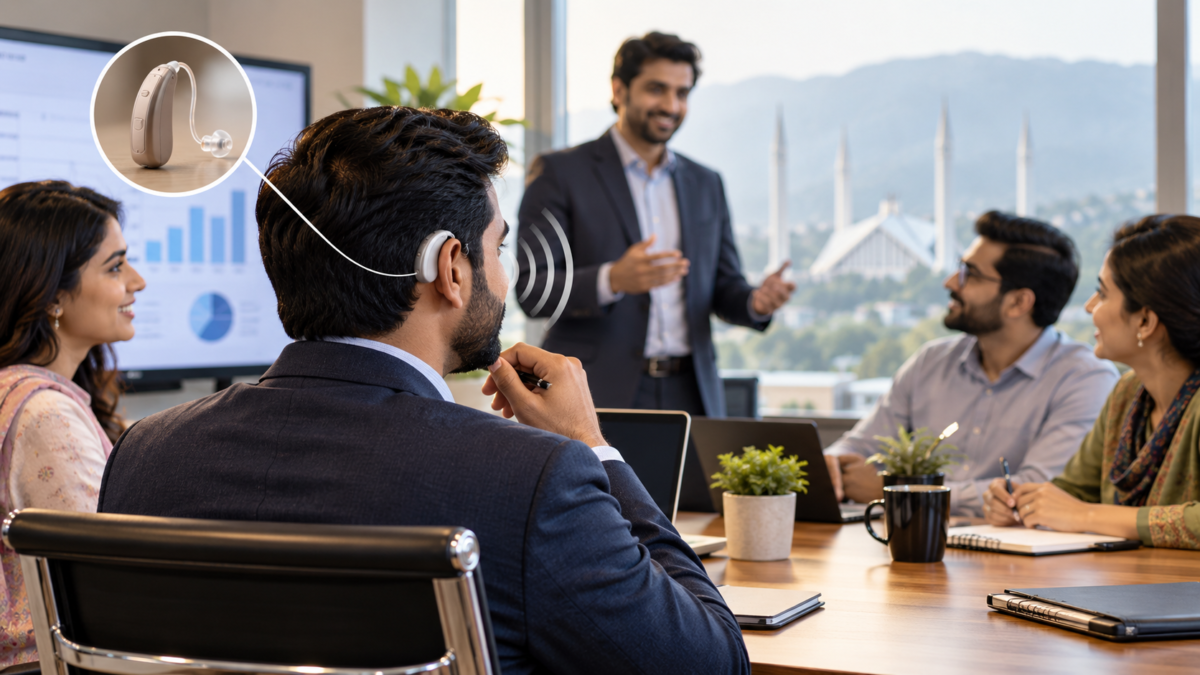
Your boss is speaking. The conference room is buzzing. Three colleagues are presenting simultaneously. You smile and nod but you didn’t hear a single word.
This happens to millions of working professionals in Pakistan every single day.
Undiagnosed or untreated hearing loss doesn’t just affect your social life. It directly threatens your career. Studies show that employees with untreated hearing loss are 50% more likely to be passed over for promotions, struggle with performance reviews, and face workplace isolation.
But here’s the hopeful part: Hearing aids at work aren’t a career liability they’re a competitive advantage.
This guide shows Pakistani professionals exactly how to use hearing aids confidently in the workplace, communicate better in meetings, and protect your career advancement. Whether you work in corporate offices in Islamabad, Karachi, Lahore, or run your own business, these strategies work.
Section 1: How Hearing Loss Damages Your Professional Career
1.1 The Silent Performance Problem
Hearing loss in the workplace doesn’t announce itself loudly. It creeps in quietly:
What Employers Notice (But Won’t Say):
- You ask colleagues to repeat information
- You miss important details in meetings
- You struggle with phone calls
- Your contributions become less frequent
- You seem “disconnected” from the team
What Colleagues Observe:
- “Why does Ali never join our coffee chats?”
- “Fatima always asks ‘what?’ in meetings”
- “He seems out of touch with the team”
- “She’s not as sharp as she used to be”
Career Impact:
❌ Lower performance ratings
❌ Fewer promotion opportunities
❌ Reduced salary increments
❌ Exclusion from important projects
❌ Decreased job security
1.2 The Real Statistics (Pakistan Context)
Research from Pakistan’s medical institutions shows:
75% of Pakistani professionals with hearing loss:
- Never disclose it to their employer
- Experience career stagnation
- Feel anxious about job security
- Avoid professional development opportunities
- Consider leaving their jobs
50% report experiencing:
- Reduced productivity
- Workplace relationship strain
- Decreased confidence in meetings
- Missed promotions
- Job satisfaction decline
The Cost: Pakistani companies lose approximately PKR 45-60 billion annually due to hearing loss-related workplace inefficiency.
1.3 Why Pakistani Workplaces Make It Worse
Pakistan’s workplace culture has unique challenges for employees with hearing loss:
Challenge 1: Loud Office Environments
- Most Pakistani offices lack proper sound treatment
- Open office layouts with minimal partitions
- Air conditioning/machinery noise
- Multiple conversations simultaneously
- Meetings in echo-prone conference rooms
Challenge 2: Social & Cultural Stigma
- Disability disclosure seen as weakness
- Fear of being stereotyped or sidelined
- Pressure to “just manage” without help
- Limited workplace accommodation culture
- Reluctance from management to adapt
Challenge 3: Limited Accommodation Awareness
- Most Pakistani HR departments lack hearing loss protocols
- No structured accommodation requests process
- Minimal workplace technology support
- Limited knowledge about hearing aid benefits
Section 2: How Modern Hearing Aids Transform Office Communication
2.1 The Workplace Hearing Aid Advantage
Modern hearing aids do far more than just amplify sound. In a professional setting, they:
Better Meeting Participation:
✔️ Focus on speaker while filtering background noise
✔️ Capture key points from multiple speakers
✔️ Reduce fatigue from concentrating so hard
✔️ Allow confident participation without struggling
Improved Telephone Communication:
✔️ Crystal-clear phone conversations
✔️ Video call clarity (with wireless connectivity)
✔️ Conference call participation without anxiety
✔️ Client communication confidence
Enhanced Relationship Building:
✔️ One-on-one conversations with colleagues
✔️ Casual office chats and socializing
✔️ Networking events and professional gatherings
✔️ Team bonding activities
Confidence & Presence:
✔️ Increased speaking up in meetings
✔️ Better decision-making input
✔️ Stronger professional relationships
✔️ Leadership capability demonstration
2.2 Advanced Hearing Aid Features for the Modern Workplace
Today’s hearing aids come with workplace-specific technology:
Directional Microphones: Focus on the speaker directly in front of you while minimizing background noise from sides and back. Perfect for conference room meetings where you need to hear the presenter clearly.
Noise Reduction Technology: Automatically distinguishes between speech and office background noise. Your hearing aids literally “tune out” the printer, air conditioner, and neighboring desk conversations.
Wireless Connectivity: Connect directly to your office phone, computer, or presentation equipment. Receive audio directly in your ears without struggling to hear from across the room.
Multiple Listening Programs: Switch between different settings for:
- One-on-one office conversations
- Conference room meetings
- Phone calls
- Open office environments
- Video conferencing
- Presentation attendance
Telephone/Mobile Optimization: Special settings for telephone calls ensure you hear every word clearly, crucial for client-facing roles and important business calls.
All-Day Comfort: Modern hearing aids provide 16+ hours of comfort with digital noise management, meaning you won’t feel fatigued by day’s end.
Section 3: Workplace Hearing Aid Types and Professional Appropriateness
3.1 Which Hearing Aids Look Most Professional?
Behind-the-Ear (BTE) – The Professional Choice
- More visible but highly professional-looking
- Excellent sound quality for meetings
- Easier to adjust and manage
- Most durable for busy workplaces
- Best for telephone use
Receiver-in-Canal (RIC) – The Discreet Option
- Nearly invisible
- Natural sound quality
- Comfortable for extended wear
- Professional appearance
- Great for client-facing roles
Completely-in-Canal (CIC) or Invisible-in-Canal (IIC) – The Invisible Solution
- 100% invisible
- Perfect if appearance is concern
- Requires frequent adjustments
- Battery changes can be challenging
- Best for low-hearing-loss situations
In-the-Canal (ITC) – The Balanced Approach
- Partially visible but discrete
- Good sound quality
- Comfortable for 8-10 hour workdays
- Professional appearance
- Easier to manage than CIC
Professional Recommendation: For most office workers in Pakistan, RIC or discrete BTE hearing aids offer the best balance of professional appearance, functionality, and workplace performance.
Section 4: Preparing for Work with Hearing Aids
4.1 Pre-Workplace Setup (First 2 Weeks)
Week 1: Adjustment at Home
- Wear hearing aids 2-4 hours daily
- Get used to sound quality and volume
- Practice with personal phone calls
- Listen to podcasts or videos
- Adjust to different listening environments
Week 2: Gradual Workplace Introduction
- Start with quiet office time (early morning)
- Practice with one-on-one conversations
- Attend non-critical meetings
- Build confidence before big presentations
- Get multiple fittings adjusted as needed
Before Your First Full Day:
✔️ Schedule fitting appointment with audiologist
✔️ Practice hearing aid insertion/removal
✔️ Learn about adjusting volume and settings
✔️ Understand battery management
✔️ Know how to troubleshoot common issues
4.2 Technical Preparation
Office Technology Compatibility:
Your Hearing Aids Should Work With:
- Office phone systems
- Mobile phones (smartphone compatibility crucial)
- Video conferencing software (Zoom, Teams, Google Meet)
- Presentation equipment
- Computer audio
- Conference room microphones
Ask Your Audiologist: “Which hearing aids will work best with my office technology?” A quality audiologist will recommend devices compatible with your specific workplace setup.
Test Before Day One:
- Connect to your office phone
- Use with your computer
- Test video call clarity
- Practice switching programs
- Ensure Bluetooth connectivity works
4.3 Spare Hearing Aids Strategy
Never Put All Eggs in One Basket:
For critical professional roles, consider having backup hearing aids:
✔️Primary Hearing Aids: Your main daily devices
✔️Backup Devices: Older or spare hearing aids for emergencies
✔️Emergency Batteries: Keep 2-3 months supply at office
Why This Matters:
- A dead battery in the middle of a client call is a career risk
- A malfunctioning device during an important meeting is unprofessional
- Having backup shows you’re prepared and professional
Cost-Effective Approach: Ask your audiologist about certified pre-owned hearing aids for backup. This costs 40-50% less than new devices.
Section 5: Professional Etiquette with Hearing Aids at Work
5.1 To Disclose or Not to Disclose?
The Pakistani Workplace Dilemma: Many professionals in Pakistan worry: “If I tell my employer about my hearing loss, will they think I’m less capable?”
The Answer: Strategic disclosure is often beneficial.
When to Disclose:
✔️ DISCLOSE IF:
- Hearing loss visibly affects your job performance
- You need workplace accommodations
- Colleagues ask why you’re wearing hearing aids
- You’re applying for a new position
- You need to explain previous communication struggles
- Your role involves meetings and communication as core function
❌ DON’T NEED TO DISCLOSE IF:
- Your hearing aids work well and no issues arise
- It doesn’t affect your job performance
- You prefer privacy (your right)
- Your role doesn’t require disclosure
- You’ve managed without accommodations
How to Disclose Professionally:
To Your Manager: “I’ve recently started using hearing aids to address some hearing loss. This will actually improve my communication in meetings and client calls. I wanted to let you know so you’re aware. It doesn’t affect my work capability it enhances it.”
To HR Department: “I’m wearing hearing aids. If there are any workplace accommodations that would help like better seating in meetings or quiet spaces for calls I’d appreciate discussing options. I’m committed to maintaining my performance standards.”
To Colleagues: Keep it casual and matter-of-fact: “I wear hearing aids. If you’re speaking to me and I don’t hear you, just repeat or tap my shoulder. No big deal.”
5.2 Professional Hearing Aid Etiquette
Meeting Room Conduct:
✔️ Arrive early and sit strategically (closer to speaker)
✔️ Face the person speaking when possible
✔️ Use directional microphone setting if available
✔️ If you didn’t hear something, ask professionally: “Could you repeat that last point?”
✔️ Don’t fake understanding politely clarify
✔️ Take notes to reduce reliance on hearing everything
One-on-One Conversations:
✔️ Face the person directly
✔️ Ask them to face you when speaking
✔️ Choose quieter locations for important discussions
✔️ Don’t be embarrassed asking for repetition
✔️ Thank people for their patience
Phone Calls:
✔️ Use hearing aid phone settings/programs
✔️ Avoid speaker phone if confidentiality is needed
✔️ In open offices, use quiet spaces for calls
✔️ Don’t rush take time to understand fully
✔️ Email follow-ups for critical information
Presentation Attendance:
✔️ Sit closer to screen/speaker
✔️ Request materials in advance
✔️ Ask questions confidently
✔️ Contribute ideas despite hearing challenges
✔️ Never pretend to understand seek clarification
5.3 Confidence & Communication Strategies
Master These Professional Communication Techniques:
Strategy 1: Strategic Positioning Seat yourself in meeting rooms where you can see the speaker clearly and hearing aid microphones work optimally. First to arrive = best seat selection.
Strategy 2: Active Note-Taking Take detailed notes during meetings. This:
- Reduces pressure to hear everything
- Shows engagement
- Provides backup documentation
- Makes you look more professional
Strategy 3: Clarification Requests Instead of: “What?” or faking understanding
Say: “Could you clarify that last point?” or “How did you arrive at that conclusion?”
This demonstrates thoughtfulness, not hearing loss.
Strategy 4: Agenda Preparation Always request meeting agendas in advance. This helps you:
- Prepare for technical terms
- Anticipate discussion topics
- Reduce cognitive load during meeting
- Participate more effectively
Strategy 5: Follow-Up Communication After meetings, send emails summarizing key points. This:
- Confirms your understanding
- Provides documentation
- Demonstrates thorough communication style
- Masks any missed information
Strategy 6: Leverage Written Communication Use email and messaging apps when appropriate. Many professionals now prefer written communication anyway, which works perfectly for hearing aid users.
Strategy 7: Build Strong Relationships Colleagues who know you well are more patient and helpful. Invest in relationships it creates a supportive environment.
Section 6: Workplace Scenario Guide – Real Pakistani Office Situations
6.1 Conference Room Meeting
The Situation: You’re in a conference room with 8 people. Your boss is speaking from one end. Multiple people are providing input. Background noise from air conditioner. You’re struggling to follow.
Professional Response:
Before Meeting:
✔️ Sit 1-2 meters from the main speaker
✔️ Ensure you can see faces clearly
✔️ Use directional microphone setting
✔️ Have pad and pen ready
During Meeting:
✔️ Face the speaker when they talk
✔️ Take notes of key points
✔️ If you miss something, write note to ask colleague later
✔️ Or wait for natural pause and ask: “Can you summarize the key action items?”
✔️ Don’t apologize just participate confidently
After Meeting:
✔️ Email summary to confirm understanding
✔️ Ask colleague if you missed anything important
✔️ Document decisions made
6.2 One-on-One Meeting with Boss
The Situation: Private meeting about performance review. Boss is speaking quickly. Formal setting. Very important you understand everything.
Professional Response:
Before Meeting:
✔️ Request agenda in advance
✔️ Prepare notes on discussion points
✔️ Choose quieter location (closed office, not open area)
During Meeting:
✔️ Face your boss directly
✔️ Ask them to face you too (frame as preference: “I hear better face-to-face”)
✔️ Take detailed notes
✔️ Ask clarifying questions confidently
✔️ Repeat back key feedback: “So if I understand correctly, you want me to improve X by improving Y?”
After Meeting:
✔️ Email summary of key points
✔️ Confirm deadlines and expectations
✔️ Demonstrate engagement with feedback
6.3 Open Office Conversation
The Situation: Colleague approaches your desk. Multiple conversations happening around. You’re straining to hear. Feeling isolated.
Professional Response:
Quick Conversation:
✔️ Face your colleague
✔️ Minimize distractions
✔️ If in doubt, ask them to step into meeting room
✔️ Be friendly and open
Longer Discussion:
✔️ Suggest moving to quieter area
✔️ Frame positively: “Let me give you my full attention”
✔️ Close office door or find quiet corner
✔️ Ensure face-to-face positioning
6.4 Client Call
The Situation: Important client call. You need to hear every word. Reputation depends on it. Anxiety is high.
Professional Response:
Before Call:
✔️ Use quiet, private space
✔️ Close door and minimize interruptions
✔️ Use hearing aid phone program if available
✔️ Have materials/notes ready
✔️ Test connection/audio quality beforehand
During Call:
✔️ Focus completely on conversation
✔️ Take notes
✔️ If you miss something: “I want to make sure I have this right…”
✔️ Confirm action items before call ends
✔️ Don’t rush clarity is professionalism
After Call:
✔️ Email summary of discussion and commitments
✔️ Verify understanding with colleague
✔️ Document agreements
6.5 Professional Presentation/Training
The Situation: You’re attending a formal presentation or training. Information is critical. You need to absorb details.
Professional Response:
Before Event:
✔️ Request presentation materials in advance
✔️ Review agenda and learning objectives
✔️ Plan your seating (closer to screen/speaker)
✔️ Prepare questions in advance
During Event:
✔️ Sit in front area
✔️ Have pen and paper ready
✔️ Take notes liberally
✔️ Ask questions confidently
✔️ Use breaks to seek clarification
After Event:
✔️ Review notes and materials
✔️ Email summary to manager
✔️ Implement learning from training
Section 7: Workplace Accommodations You Can Request
7.1 Legal & Ethical Accommodations in Pakistan
Under Pakistan’s labor laws and international disability standards, reasonable workplace accommodations are fair to request.
You Can Request:
Environmental Accommodations:
- Quieter workspace or modified seating
- Use of private meeting rooms for important conversations
- Reduced ambient noise (quieter office area)
- Better lighting (for lip-reading if needed)
- Accessibility to quiet spaces for concentration
Communication Accommodations:
- Meetings in quieter locations
- Meeting agendas provided in advance
- Written meeting summaries/notes
- Email summaries of verbal information
- Preference for written communication when possible
Technology Accommodations:
- Compatible phone systems
- Video conferencing when preferred over phone
- Presentation materials in advance
- Captioning for training videos
- Hearing loop systems in meeting rooms
Scheduling Accommodations:
- Slightly flexible meeting times for preparation
- Advance notice of important discussions
- Sufficient time between back-to-back meetings
Most accommodations are free or very low-cost to implement.
7.2 How to Request Accommodations Professionally
Frame Your Request Positively:
❌ Wrong: “I can’t hear in meetings. I need accommodation.”
✔️ Right: “I’d like to suggest a seating arrangement in meetings that will help me contribute more effectively.”
❌ Wrong: “My hearing loss makes me unable to…”
✔️ Right: “To ensure I’m fully engaged in important discussions, I’d like to…”
Approach Your HR Manager:
“I’ve recently started using hearing aids and want to ensure I can perform at my best. I’d like to discuss a few simple accommodations that would help. Most are no-cost solutions like meeting room selection and agenda sharing.”
Make It About Performance:
Frame all accommodations as ways to improve your job performance, not special treatment. Employers respond better to: “This will improve my productivity” than “I have a disability.”
Section 8: Technology Solutions for Workplace Hearing
8.1 Latest Hearing Aid Technology for Office Use
Direct Audio Streaming: Modern hearing aids stream phone audio, computer audio, and video conference directly to your ears. No more struggling to hear through speakers.
Artificial Intelligence (AI) Hearing Aids: AI-powered devices automatically adjust to office environments in real-time, learning your preferences and optimizing settings for different scenarios.
Smartphone Apps: Control your hearing aids directly from your phone:
- Adjust volume
- Switch listening programs
- Find your hearing aids if lost
- Stream phone calls
- Customize settings per location
Real-Time Conversation Subtitles: Some modern apps provide live captions during conversations, perfect for noisy office environments or phone calls.
Hearing Loop Systems: Advanced office buildings install hearing loop systems in conference rooms. Your hearing aids connect wirelessly to these systems, receiving crystal-clear audio directly.
8.2 Supporting Office Technology
Recommended Device Setup:
Essential:
✔️ Compatible office phone system
✔️ Smartphone with hearing aid app
✔️ Computer with video conferencing capability
Highly Recommended:
✔️ Video conferencing software that works well with hearing aids
✔️ Wireless microphone system for presentations
✔️ Quality headset for backup option
Nice to Have:
✔️ Hearing loop system in meeting rooms
✔️ Automatic captioning on video calls
✔️ Professional sound quality in office environment
Section 9: Managing Hearing Aid Maintenance at Work
9.1 Battery Management & Power Solutions
Battery Fatigue: Most hearing aid batteries last 5-7 days. A full workday uses significant battery life, especially with constant meetings.
Office Battery Strategy:
- Change batteries weekly (Friday evening before leaving office)
- Keep 2-3 spare sets in office drawer
- Consider rechargeable hearing aids (charge overnight)
- Never run on low battery for important meetings
Rechargeable Advantage: If your schedule allows, rechargeable hearing aids eliminate battery anxiety. Charge overnight, come to office fully powered.
9.2 Hearing Aid Care at Work
Keep Your Hearing Aids Professional:
✔️ Clean daily (morning/evening)
✔️ Avoid moisture in office bathrooms
✔️ Store safely at night
✔️ Check for earwax buildup
✔️ Inspect for damage regularly
✔️ Keep maintenance schedule with audiologist
Emergency Supplies for Office:
- Replacement batteries
- Cleaning brush
- Dry storage container
- Replacement ear piece (if using BTE aids)
- Contact details of audiology center
When Hearing Aids Malfunction:
- Have backup device (used hearing aid or older model)
- Know your audiologist’s emergency contact
- Keep maintenance appointment schedule visible
- Never miss important meeting due to hearing aid issue
9.3 Workplace Microphone & Speaker Etiquette
Using Office Equipment Professionally:
When speaking in meetings:
✔️ Use microphone if provided
✔️ Speak clearly into microphone
✔️ Don’t adjust microphone excessively
✔️ Let audio technician handle equipment
When listening:
✔️ Ask for microphone if speaker is far away
✔️ Request volume adjustment professionally
✔️ Don’t draw attention to hearing aid struggles
✔️ Ask technical questions to organizer
Section 10: Success Strategies for Career Advancement with Hearing Aids
10.1 Positioning Yourself for Promotion
Hearing loss shouldn’t hold you back from advancement. Strategic positioning ensures it doesn’t.
Leadership Visibility:
- Participate confidently in meetings (prepare well)
- Contribute thoughtful ideas (take notes, think deeply)
- Build strong relationships (people trust you)
- Demonstrate reliability (follow through on commitments)
- Show professional growth (continuous improvement)
Meeting Contribution Strategy: Before each meeting:
- Review agenda (if available)
- Prepare 2-3 thoughtful contributions
- Note key points to mention
- Plan questions to ask
This preparation compensates for any hearing challenges and makes you look more thoughtful.
Documentation of Achievements:
- Email summaries of your work
- Document accomplishments promptly
- Share successes with manager
- Build visible track record
Hearing challenges disappear when your work speaks for itself.
10.2 Overcoming Workplace Hearing Loss Stereotypes
The Stereotype: “People with hearing loss are less capable”
The Reality: Many brilliant professionals use hearing aids successfully
Combat Stereotypes By:
✔️ Demonstrating excellence in your work
✔️ Being confident, not apologetic
✔️ Taking ownership of communication
✔️ Showing you’re professional and prepared
✔️ Building relationships through competence
✔️ Handling hearing challenges matter-of-factly
Never:
❌ Use hearing loss as excuse for mistakes
❌ Appear helpless or dependent
❌ Draw attention to communication struggles
❌ Miss important information due to lack of effort
❌ Apologize excessively for hearing loss
10.3 Building Professional Relationships Despite Hearing Loss
Stronger Relationships = Better Career Opportunities
One-on-One Relationship Building:
- Suggest coffee meetings (better for hearing)
- Have lunch with colleagues (casual conversation)
- Attend team events (show engagement)
- Participate in informal gatherings
- Engage in meaningful conversations
Team Participation:
- Contribute to team projects visibly
- Help colleagues when possible
- Participate in team discussions
- Share ideas and perspectives
- Show genuine interest in colleagues
Relationship Maintenance:
- Remember personal details about colleagues
- Follow up on their projects/lives
- Show appreciation for help received
- Build reputation for reliability
- Demonstrate genuine care
Colleagues who like you personally are more patient and supportive of communication needs.
10.4 Addressing Workplace Hearing Loss Discrimination
Know Your Rights: In Pakistan, workplace discrimination based on disability is unethical and often violates labor laws.
If You Experience Discrimination:
Document Everything:
- Date, time, and details of incidents
- What was said or done
- Who witnessed it
- Your response
- Impact on your work
Address Professionally:
- Meet privately with manager/HR
- Present incidents factually
- Explain impact on your work environment
- Request specific resolution
- Ask for written documentation
Escalate if Needed:
- Contact HR formally
- Request workplace accommodation mediation
- Involve labor representative if applicable
- Document all communications
- Know your company’s grievance procedure
External Support:
- Contact Pakistan’s Department of Labor
- Reach out to disability rights organizations
- Consult employment lawyer if necessary
- File formal complaint if harassment continues
Section 11: Real Pakistani Professional Success Stories
Case Study 1: Farah – Corporate Executive
The Challenge: Farah worked as Operations Manager in a Karachi software company. She started experiencing hearing loss around age 45 but hid it for 2 years, struggling in meetings and making mistakes.
The Crisis: After missing critical points in a client meeting, Farah finally got hearing aids. Initially, she worried about her career.
The Solution:
- Disclosed to her manager professionally
- Requested meeting accommodations
- Used hearing aid technology to improve focus
- Increased meeting contributions
The Result: Within 6 months, Farah’s performance improved noticeably. She was promoted to Senior Manager. Her colleagues actually didn’t mind her hearing aids they appreciated her improved communication.
Key Lesson: “My hearing aids didn’t end my career. Hiding them almost did. Being open and professional saved my career trajectory.”
Case Study 2: Ahmed – Sales Professional
The Challenge: Ahmed’s job as B2B Sales Manager in Lahore required constant phone calls and client meetings. Untreated hearing loss was killing his sales numbers.
The Crisis: Ahmed nearly lost a major account because he misunderstood client requirements on a call.
The Solution:
- Got hearing aids with excellent phone quality
- Used video calls instead of phone calls (with subtitles)
- Took detailed written notes
- Confirmed understanding via email
- Built better client relationships through clear communication
The Result: Ahmed’s sales improved by 35% within 3 months. He’s now his company’s top performer. Clients appreciate the clear communication style.
Key Lesson: “Hearing aids weren’t a career risk they were a performance upgrade. My sales numbers prove it.”
Case Study 3: Saira – Bank Manager
The Challenge: Saira manages a team of 12 people in Islamabad. Hearing loss made her feel disconnected from her team and worried about leadership capability.
The Crisis: Saira received feedback that she seemed “distracted” and “out of touch.” Team morale was suffering.
The Solution:
- Got hearing aids to improve team interactions
- Improved one-on-one meeting communication
- Used written communication more (also improved documentation)
- Showed more engagement in team discussions
- Built stronger team relationships
The Result: Within 4 months, team feedback improved dramatically. Employee satisfaction scores increased. Saira was more present and engaged.
Key Lesson: “Hearing aids didn’t make me a worse manager. They made me a better one because I could actually hear my team.”
FAQ – Workplace Hearing Aid Questions
Q1: Will my colleagues think I’m incompetent if I wear hearing aids?
A: No. Modern hearing aids are discrete. Even if visible, they signal that you’re professional enough to address health issues. Most colleagues won’t notice or care. Those who do will respect your proactive approach.
Q2: Should I mention my hearing aids in job interviews?
A: Only if asked about medical conditions. If asked about hearing: “I use hearing aids. This doesn’t affect my job performance it enhances my ability to communicate clearly.” Frame it positively.
Q3: Will hearing aids affect my credibility in meetings?
A: The opposite. Hearing aids actually increase credibility because:
- You participate more confidently
- You ask intelligent clarifying questions
- You contribute more thoughtfully
- You take better notes
- You follow through more carefully
Q4: What if my office environment is very noisy?
A: Modern hearing aids handle noise excellently. Talk to your audiologist about hearing aids specifically designed for noisy environments. You can also request quieter workspace, which employers often accommodate.
Q5: Can hearing aids work with my office phone system?
A: Most modern hearing aids work with compatible phone systems. Check with your audiologist about your specific office setup. Wireless connectivity is increasingly standard.
Q6: Should I tell my boss about my hearing loss?
A: It depends on impact to your job. If it affects performance or you need accommodations, yes. If you manage fine without disclosure, it’s your choice. Strategic disclosure is often beneficial.
Q7: What if people make jokes about my hearing aids?
A: Address it professionally and lightly:
- “Hearing aids help me do my job better”
- “Better than pretending to understand and making mistakes”
- “Yeah, modern medicine is pretty cool”
Then move conversation forward. Most jokes stop when met with confidence.
Q8: Can I use hearing aids during video conferences?
A: Yes! Many hearing aids connect directly to video conferencing apps, streaming audio directly to your ears. Often works better than speakers.
Q9: What’s the cost of workplace-appropriate hearing aids?
A: Range from PKR 80,000 to 300,000+ depending on features. Workplace quality hearing aids with directional microphones and phone compatibility start around PKR 100,000-150,000, which is worthwhile investment in career.
Q10: How do I handle hearing loss affecting my work performance?
A: Take action immediately:
- Get hearing test
- Obtain hearing aids
- Adjust to office environment
- Request accommodations if needed
- Document improved performance
- Build confidence through preparation
Don’t let hearing loss quietly damage career.
Section 13: Action Plan – Your Workplace Hearing Solution
This Month: Assessment & Planning
Week 1:
- Schedule comprehensive hearing test
- Get audiological report
- Assess impact on current job performance
- Identify specific workplace challenges
Week 2:
- Research hearing aid options suitable for office
- Get professional recommendations
- Understand technology features needed
- Review pricing and financing
Week 3:
- Make hearing aid purchase decision
- Complete fitting appointments
- Learn device operation and settings
- Practice with office technology
Week 4:
- Adjust to hearing aids in home environment
- Practice various listening scenarios
- Prepare for workplace introduction
- Plan disclosure strategy (if applicable)
Next Month: Workplace Integration
Week 1:
- Introduce hearing aids at work gradually
- Start with non-critical meetings
- Assess comfort level
- Make adjustment fine-tuning appointments
Week 2:
- Increase workplace confidence
- Participate in regular meetings
- Practice new communication strategies
- Build professional relationships
Week 3:
- Integrate fully into work activities
- Attend important meetings confidently
- Utilize accommodation strategies
- Assess performance improvements
Week 4:
- Confirm hearing aids are working well
- Schedule maintenance with audiologist
- Establish office hearing aid routine
- Plan long-term success strategy
Ongoing: Career Advancement
Monthly:
- Hearing aid maintenance and battery management
- Audiologist follow-up appointments
- Communication strategy review
- Professional relationship building
Quarterly:
- Performance review and improvement tracking
- Career development planning
- Technology updates (if needed)
- Confidence assessment
Annually:
- Hearing test update
- Hearing aid effectiveness review
- Career advancement evaluation
- Long-term hearing care planning
Conclusion: Hearing Aids Are Your Career Asset
In Pakistan’s competitive job market, every advantage matters. Treating hearing loss isn’t just a health choice it’s a career strategy.
The professionals thriving in Pakistani workplaces aren’t those who pretend their hearing is fine. They’re the ones who take action, adapt, and compete on a level playing field.
With modern hearing aids, proper preparation, and professional strategies, hearing loss becomes a non-issue. What remains is your competence, your commitment, and your contributions all enhanced by clear communication.
Your Hearing, Your Career, Your Success
Don’t let untreated hearing loss quietly damage your professional growth. Don’t watch promotions go to others because you struggled in meetings. Don’t feel isolated from your team because you couldn’t participate fully.
Take control today. Your career tomorrow depends on the decisions you make now.
Book Your Free Professional Hearing Consultation Today
📱 WhatsApp: +92 336 5784920
📧 Email: info@ihchearing.com
🌐 Visit: Islamabad Hearing Center, G-8 Markaz, Islamabad