Your hearing aid has stopped working. Maybe the sound has become weak or distorted. Maybe it is making a whistling noise, cutting in and out, or simply producing no sound at all. Whatever the issue, the moment your hearing aid fails you, daily life becomes instantly more difficult. Conversations are harder to follow. Noise from the environment becomes overwhelming without the clarity you have come to rely on. And the most common question people in Pakistan search for in that moment is this: where can I get my hearing aid repaired, and what will it involve?
This guide answers exactly that. Whether your hearing aid is a Phonak, Signia, Widex, Oticon, Rexton, Starkey, Bernafon, Unitron, Resound, or any other brand, this is everything you need to know before you walk into a hearing aid laboratory in Pakistan — what to check yourself first, what a qualified lab does, how to know if your device needs repair or replacement, what the repair process looks like, and how to find a trustworthy service center in Islamabad or across Pakistan.
Why Hearing Aids Stop Working: The Most Common Causes
Understanding what causes a hearing aid to malfunction helps you communicate clearly with the lab technician and also helps you perform a few basic checks before making the trip. Many hearing aid problems have simple solutions that do not require any professional intervention at all.
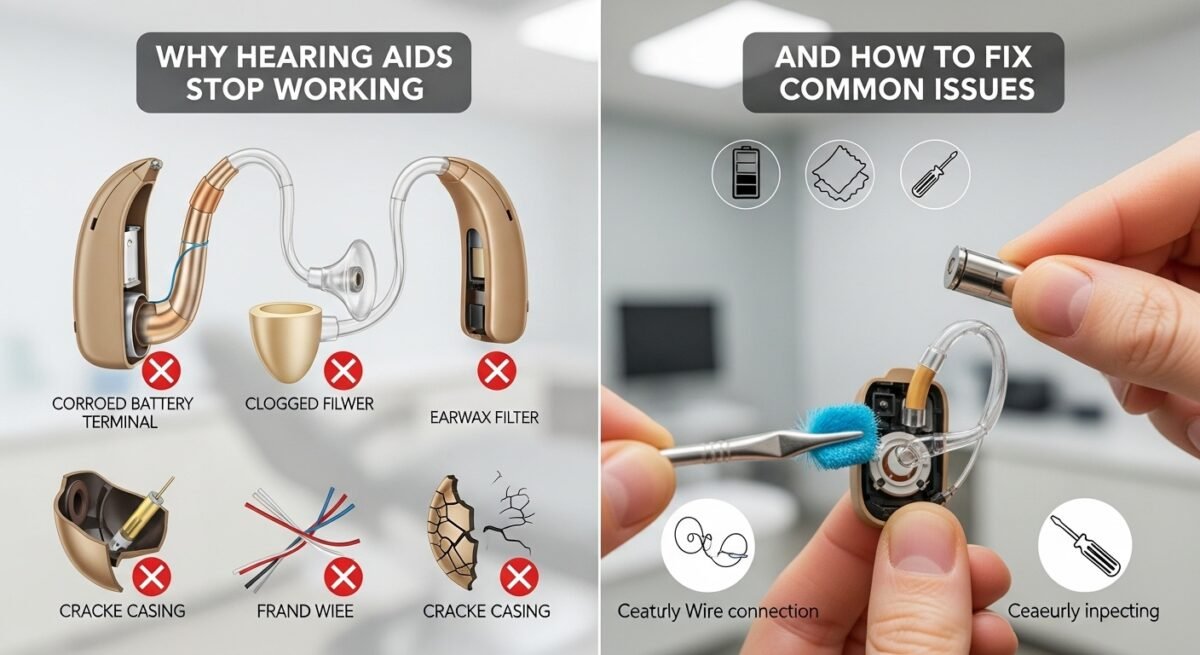
The most frequent cause of hearing aid failure in Pakistan is moisture and humidity. Pakistan’s climate, particularly during monsoon season, creates conditions that are damaging to the sensitive electronics inside hearing aids. Sweat from daily wear accumulates in the device over time, and without regular drying, this moisture causes corrosion, intermittent sound, or complete failure.
Earwax blockage is the second most common cause. The microphone inlet and sound outlet ports on a hearing aid are tiny, and earwax naturally migrates toward them during wear. A blocked port produces muffled or absent sound even when the device is functioning electrically. Many patients assume their hearing aid has broken when it simply needs a careful clean.
Battery or charging issues account for a large proportion of complaints, particularly with older devices that use disposable batteries. A corroded battery contact, a battery that was inserted incorrectly, or a depleted battery that was left inside the device can all prevent the hearing aid from functioning. For rechargeable devices, a damaged charging case or charging port is often the issue rather than the hearing aid itself.
Physical damage from drops is another regular occurrence. Hearing aids are small, lightweight devices and they are worn every day. Dropping them on hard flooring, particularly tiles or concrete, can crack the casing, damage the receiver, dislodge internal components, or break the earmould connection. This type of damage is usually visible but not always immediately obvious.
Finally, programming drift or outdated settings cause problems that many patients do not recognise as a technical issue. If your hearing has changed since your last audiological assessment, your hearing aid settings no longer match your hearing profile. The device may be functioning perfectly in a technical sense but delivering poor sound quality because it is programmed for a hearing level you no longer have. This requires reprogramming rather than physical repair. You can read more about how hearing aids are fitted and fine-tuned on our hearing aids page.
What to Check at Home Before Visiting a Repair Lab
Before contacting a hearing aid laboratory, there are several things you can check yourself that may resolve the problem without a lab visit.
Start with the battery. For devices using disposable batteries, replace the battery with a fresh one from a new packet, making sure to remove the sticker tab fully and wait 60 seconds before closing the battery door. This allows the zinc-air battery to activate properly. For rechargeable hearing aids, place the device back in the charging case for a full charge cycle and ensure the case itself has power.
Check the earmould or dome for blockage. Use the cleaning tool provided with your hearing aid — usually a small wire loop or brush — to gently remove any visible earwax from the sound outlet. If your hearing aid came with a wax filter or wax guard (a small white disc in the sound outlet), check whether it has become blocked and replace it if one is available. Replacement wax guards are a consumable item and are inexpensive and widely available at IHC’s hearing aid service center.
Dry the device overnight using a hearing aid drying kit or a simple desiccant jar. Remove the battery before drying. Many intermittent sound issues caused by moisture resolve after a proper overnight drying session.
Check that the hearing aid is turned on and set to the correct program. Some hearing aids have a manual volume or program button that can accidentally be changed during wear, resulting in unexpected sound quality or an unfamiliar listening mode.
If none of these steps resolve the issue, the device needs professional attention and it is time to visit a qualified hearing aid laboratory.
What Happens at a Professional Hearing Aid Repair Laboratory?
A professional hearing aid laboratory in Pakistan should be equipped to handle both straightforward maintenance tasks and complex technical repairs. Understanding what a lab does helps you set realistic expectations for turnaround time and cost.
Initial Assessment and Cleaning
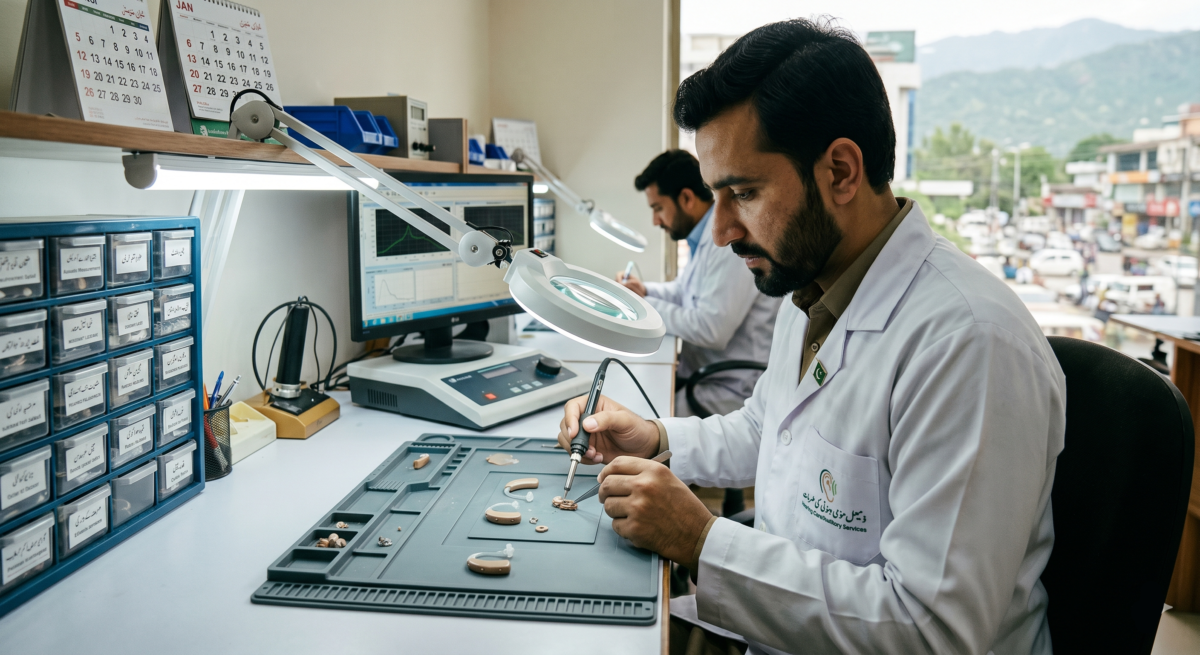
The first thing a qualified technician does upon receiving a hearing aid is a full visual inspection and deep clean. This goes far beyond what a patient can do at home. The lab cleans internal microphone ports, receiver openings, vent channels, and all accessible surfaces using professional tools. In many cases, this cleaning alone restores full function.
Electroacoustic Analysis
A well-equipped hearing aid laboratory uses electroacoustic measurement equipment to assess the hearing aid’s actual output against its manufacturer specifications. This analysis measures the device’s gain, frequency response, and maximum output to determine whether the hearing aid is performing as it should. If the measurements fall outside specification, the technician knows exactly which component or setting is responsible.
Component-Level Repair
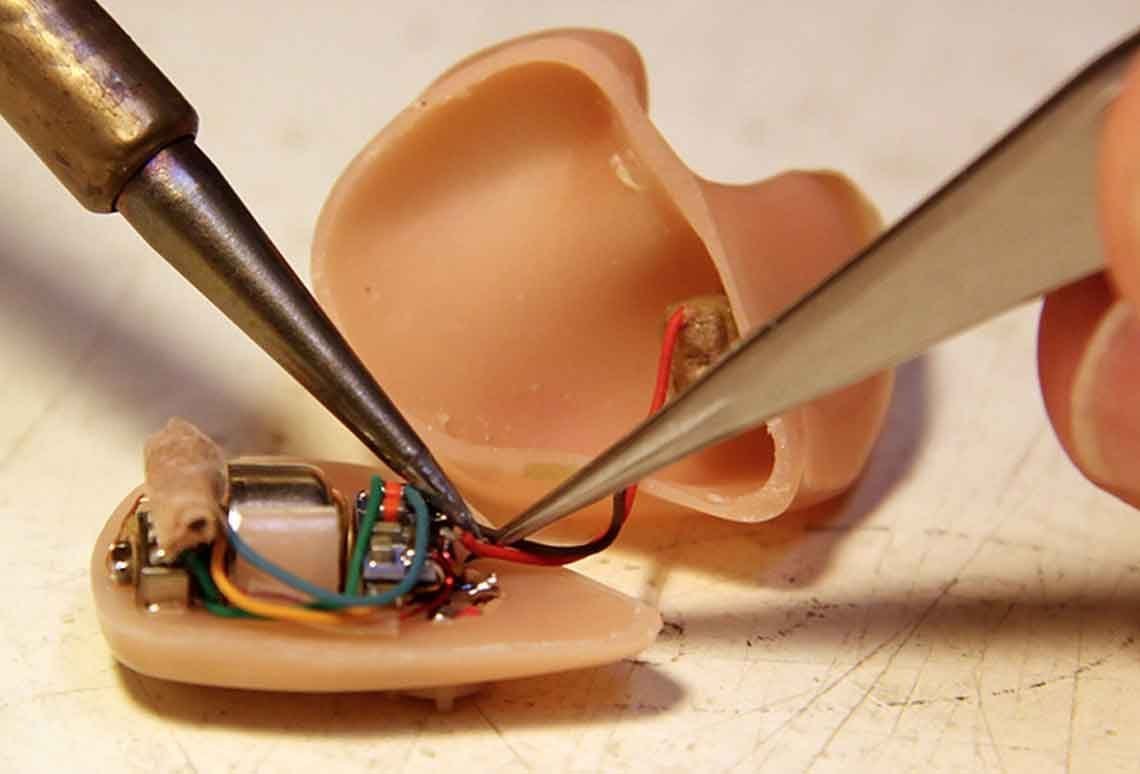
This is where the difference between a genuine hearing aid laboratory and a general electronics repair shop becomes critical. Hearing aids contain miniaturised components that require specialist knowledge and tools to service. At a professional lab, technicians can repair or replace individual components including microphones, receivers (speakers), telecoils, switches, wiring, DSP chips, programming modules, and the casing shell or faceplate. This type of circuit-level repair work requires technicians trained specifically in hearing aid electronics, not general electronics engineers.
At Islamabad Hearing Center, our hearing aid laboratory is staffed by internationally trained engineers who have been trained in Turkey and have hands-on experience with over 20 international hearing aid brands. The lab provides circuit-level repair, receiver replacement, microphone replacement, shell and casing repair, earmould manufacturing, and complete device servicing.
Reprogramming and Fine-Tuning
After a physical repair, the device often needs to be reprogrammed to verify that the settings are still correctly matched to the patient’s audiogram. A professional lab has the manufacturer software and fitting tools required to reprogram Phonak, Signia, Widex, Oticon, Rexton, Starkey, Bernafon, Unitron, Resound, and other major brands. If your hearing has changed since your device was last fitted, the lab visit is also an opportunity to update the programming. This is best done alongside an updated hearing test to ensure the reprogramming reflects your current hearing profile accurately.
Earmould and Shell Services
Custom hearing aids (CIC, ITC, ITE, and IIC styles) have shells that are moulded to the individual ear canal. Over time, these shells can crack, become ill-fitting as the ear changes shape with age, or develop sound leaks that cause feedback (whistling). A hearing aid laboratory can manufacture new earmoulds from an ear impression, repair cracked shells, or perform reshelling, which involves fitting your existing hearing aid electronics into a newly manufactured custom shell. This service extends the life of an otherwise well-functioning device considerably.
Hearing Aid Repair vs Hearing Aid Replacement: How to Know Which You Need
One of the most important conversations you will have with a hearing aid technician is whether repairing your existing device makes financial and clinical sense compared to replacing it with a new one. This is a genuine question and deserves a transparent answer.
Repair is usually the right choice when the device is relatively recent (within five to seven years old), when the damage is isolated to a specific component such as a receiver or microphone, when the casing or shell needs refurbishment rather than full replacement, and when the hearing aid’s technology still matches the patient’s hearing needs and lifestyle requirements.
Replacement becomes the more sensible option when the device is older than seven to ten years and the technology is significantly behind current standards, when the cost of repairing multiple failed components approaches or exceeds the cost of a new entry-level device, when the patient’s hearing has changed substantially and the existing device can no longer be programmed to meet their current hearing thresholds, or when the manufacturer no longer produces spare parts or software for that model.
In Pakistan’s hearing aid market, where patients have made a significant financial investment in their devices, repair is often underutilised simply because patients do not know that professional laboratory repair is available. The assumption that a broken hearing aid must be replaced is common and frequently incorrect. A qualified lab visit is almost always worth pursuing before committing to the cost of a new device.
Our blog on why hearing aids stop working and how to fix common issues covers the most frequent technical problems and their typical resolution pathways in more detail.
Hearing Aid Brands That IHC Laboratory Services in Pakistan
One of the most practical questions patients ask is whether a particular laboratory can service their specific hearing aid brand. Not all repair centers in Pakistan have the software licenses, fitting tools, and spare parts required to service all brands.
At IHC’s hearing aid laboratory, we provide professional repair, programming, and servicing for all major international hearing aid brands including Phonak, Signia, Widex, Oticon, Beltone, Starkey, Resound, Unitron, Rexton, Hansaton, Bernafon, Sonic Innovations, and more. This multi-brand capability is a significant advantage for patients who purchased their hearing aid from a different provider or who bought their device abroad and have returned to Pakistan.
For patients using Phonak devices specifically, you can learn about the full range we supply and support on our Phonak hearing aids page. Similar information is available for Widex, Oticon, Rexton, and Signia on our website.
What to Bring When You Visit a Hearing Aid Repair Lab
Coming prepared for your lab visit saves time and helps the technician diagnose the problem more accurately.
Bring the hearing aid itself along with its charging case if it is a rechargeable model, or a supply of the batteries it uses. Bring any accessories that came with the device such as the cleaning kit, programming remote, or smartphone connectivity dongle, as these may be relevant to the issue you are experiencing.
If you have a copy of your most recent audiogram or hearing test report, bring that as well. This allows the technician to verify whether the hearing aid’s current programming matches your hearing profile and to identify whether reprogramming is needed alongside the physical repair. If you do not have a recent audiogram, IHC can conduct a full hearing assessment at the same visit to ensure any reprogramming is based on your current hearing status.
If your device is still under warranty, bring any documentation you received at the time of purchase, including the warranty card or purchase receipt. This is important in Pakistan because warranty terms vary between suppliers, and having documentation avoids disputes about coverage.
Warranty Repairs vs Out-of-Warranty Repairs in Pakistan
Understanding how hearing aid warranties work in Pakistan helps you avoid unnecessary repair costs and ensures you make full use of any coverage you are entitled to.
Most international hearing aid brands provide a manufacturer warranty of one to three years from the date of purchase. This warranty typically covers manufacturing defects and component failures that occur under normal use conditions. Physical damage caused by dropping the device, moisture ingress beyond normal humidity levels, and user modifications are usually excluded from warranty coverage.
In Pakistan, warranty repairs are handled through authorized service channels. If you purchased your hearing aid from IHC, your device falls under our warranty support system and the repair process is straightforward. If you purchased from another supplier, the warranty claim process depends on whether the original supplier has a service agreement with the manufacturer for repairs in Pakistan.
For out-of-warranty repairs, the cost depends on the nature of the fault, the brand, and the component being replaced. Simple receiver replacements, wax guard changes, and cleaning services are among the most affordable repairs. Circuit-level repairs involving DSP components or complete receiver module replacements sit at a higher price point but remain significantly less expensive than purchasing a new hearing aid. The IHC laboratory provides transparent cost estimates before proceeding with any repair so patients can make an informed decision.
According to Hearing Loss Association of America, regular maintenance and timely professional servicing can extend the useful life of a hearing aid by several years, making a modest repair investment highly worthwhile from a long-term value perspective.
How Long Does Hearing Aid Repair Take in Pakistan?
Turnaround time for hearing aid repairs in Pakistan varies depending on the type of repair and whether parts need to be ordered. Here is a practical guide to what you can expect.
Basic cleaning, wax guard replacement, and minor adjustments are typically completed on the same day or during the visit itself. Battery contact cleaning and moisture removal can also usually be resolved in a single session.
Reprogramming and fine-tuning, including a software update for the device, generally takes a few hours. If an updated audiogram is conducted at the same visit, allow a half-day appointment to cover both the hearing test and the programming update.
Component-level repairs, including receiver replacement, microphone replacement, or shell repair, typically take between one to three working days if parts are available at the laboratory. For less common models or older hearing aids where parts need to be sourced, the timeframe may extend further.
Reshelling or earmould manufacturing requires a new ear impression to be taken first, followed by the manufacturing process, which typically takes three to five working days depending on the complexity of the custom mould being made.
For patients who rely on their hearing aid daily and cannot be without it during a repair period, IHC recommends discussing a loan device arrangement at the time of booking. Call our team on 051 8899990 or WhatsApp us at +92 336 5784920 to discuss this option before your visit.
Regular Maintenance: How to Avoid Frequent Repairs
Prevention is always better than cure, and most premature hearing aid failures in Pakistan are avoidable with simple daily maintenance habits.
Clean your hearing aid every evening using the cleaning brush and wire loop provided in your cleaning kit. Pay particular attention to the microphone inlets and sound outlet ports where earwax accumulates. Never use water, alcohol, or cleaning sprays directly on the hearing aid.
Use a drying kit or dehumidifier every night. A simple desiccant capsule jar costs very little and significantly extends the life of the electronics by removing moisture that accumulates from sweat and humidity during the day.
Remove your hearing aid before showering, swimming, or using hair products. Even hearing aids marketed as water-resistant have limits and are not designed for direct water immersion.
Replace wax guards regularly, approximately every four to six weeks depending on your level of earwax production. Blocked wax guards are the single most common cause of poor sound quality and one of the simplest things to maintain with regular replacement.
Have your hearing aid professionally serviced every twelve months even if it appears to be functioning well. An annual lab visit allows the technician to clean internal components, verify the electroacoustic output against specifications, and catch any developing issues before they cause complete failure.
If you are unsure about the correct maintenance routine for your specific hearing aid brand and style, our team at IHC can walk you through the process during any visit to the laboratory. You can find our complete branch locations and contact details on our contact page.
Hearing Aid Repair for Patients Outside Islamabad
A common concern for patients in cities other than Islamabad is whether professional hearing aid repair services are accessible to them. At IHC, this is something we have specifically addressed through our nationwide branch network.
IHC operates full hearing aid service facilities across Islamabad, Rawalpindi, Peshawar, Faisalabad, Karachi, Multan, Sargodha, Muzaffarabad, Rawalakot, and Bagh City in Azad Kashmir. Patients in all of these cities can access professional hearing aid repair, programming, and earmould services at their nearest branch without needing to travel to the head office.
For patients in areas not covered by a branch, we also offer remote support services. Patients can share their device details, symptoms, and audiogram with our team via WhatsApp, and our engineers provide initial guidance on whether the issue can be resolved at home or requires a physical lab visit. In some cases, patients can courier their device to our laboratory, and we return it after repair. Contact us at +92 336 5784920 to discuss the remote repair process if you are located away from our branches.
Frequently Asked Questions About Hearing Aid Repair in Pakistan
Can any electronics shop repair a hearing aid in Pakistan?
No. Hearing aids contain specialist microelectronic components that require specific tools, software, and training to service correctly. A general electronics technician can cause further damage by attempting a repair without the appropriate equipment. Always use a dedicated hearing aid laboratory with brand-specific programming software.
My hearing aid is from abroad. Can IHC repair it?
Yes. IHC services hearing aids purchased internationally, including devices bought in the UK, USA, Europe, and the Gulf. As long as the brand is among those we support, our engineers can reprogram and repair it. Bring any documentation or audiogram you have from the original fitting.
How much does hearing aid repair cost in Pakistan?
Costs vary depending on the brand, the type of fault, and whether parts are required. Simple cleaning and wax guard replacement is minimal cost. Receiver or microphone replacement involves a component cost plus a service fee. Contact our team for a transparent estimate before committing to any repair.
Can I get my hearing aid reprogrammed without a new hearing test?
Technically yes, if your audiogram is recent (within the last 12 to 18 months). However, if your hearing has changed or if it has been longer than that since your last test, we recommend a fresh PTA test or full hearing assessment at the same visit to ensure the new programming accurately reflects your current hearing needs.
What if my hearing aid cannot be repaired?
If a device is beyond economical repair, our team will advise you honestly and clearly, and guide you through the options for a replacement device. We carry hearing aids across all technology levels and price points, and we offer a 100% risk-free trial period on new devices so you are never committed to a purchase you are not satisfied with.
Why Choose IHC for Hearing Aid Repair in Pakistan?
Islamabad Hearing Center has operated Pakistan’s most advanced hearing aid laboratory since 2009. Our technical team includes internationally trained engineers with hands-on experience in circuit-level repair across more than 20 major hearing aid brands. We hold manufacturer software licenses for multi-brand programming, operate a fully equipped electroacoustic measurement facility, and manufacture custom earmoulds and shells in-house.
What sets IHC apart from general repair shops or smaller clinics is the combination of clinical and technical expertise under one roof. When your hearing aid comes in for a repair, it is not just assessed by a technician — it is reviewed against your hearing profile by a qualified audiologist who ensures the repaired and reprogrammed device actually meets your listening needs when it leaves the lab.
We understand that your hearing aid is not just a device. It is your daily connection to conversations, to family, to work, and to the world around you. Getting it back to full function quickly and correctly is a matter we take seriously.
To book your hearing aid for a repair assessment at any IHC branch across Pakistan, call us on 051 8899990, WhatsApp us at +92 336 5784920, or visit our contact page to find the branch nearest to you.
Final Thoughts
Getting a hearing aid repaired in Pakistan does not need to be a stressful or uncertain experience. With the right knowledge about what causes hearing aid problems, what to check at home before visiting a lab, and what a professional laboratory service actually involves, you can approach the repair process with confidence.
The key is choosing a laboratory that has the brand expertise, the clinical knowledge, and the technical infrastructure to do the job properly. A poorly repaired hearing aid can perform worse after the visit than before it, which is why the choice of service provider matters as much as the decision to seek repair in the first place.
IHC’s hearing aid laboratory is available to patients across Pakistan, and our team is always ready to assess your device, advise on the right course of action, and return your hearing aid to you in the best possible condition. You can also read more about why maintaining your hearing technology properly matters in our related blog on why hearing aids stop working and how to fix common issues.
If you are also considering whether your hearing has changed since your device was last fitted, our full range of hearing assessment services is available at all major IHC branches and can be scheduled alongside your repair visit on the same day.