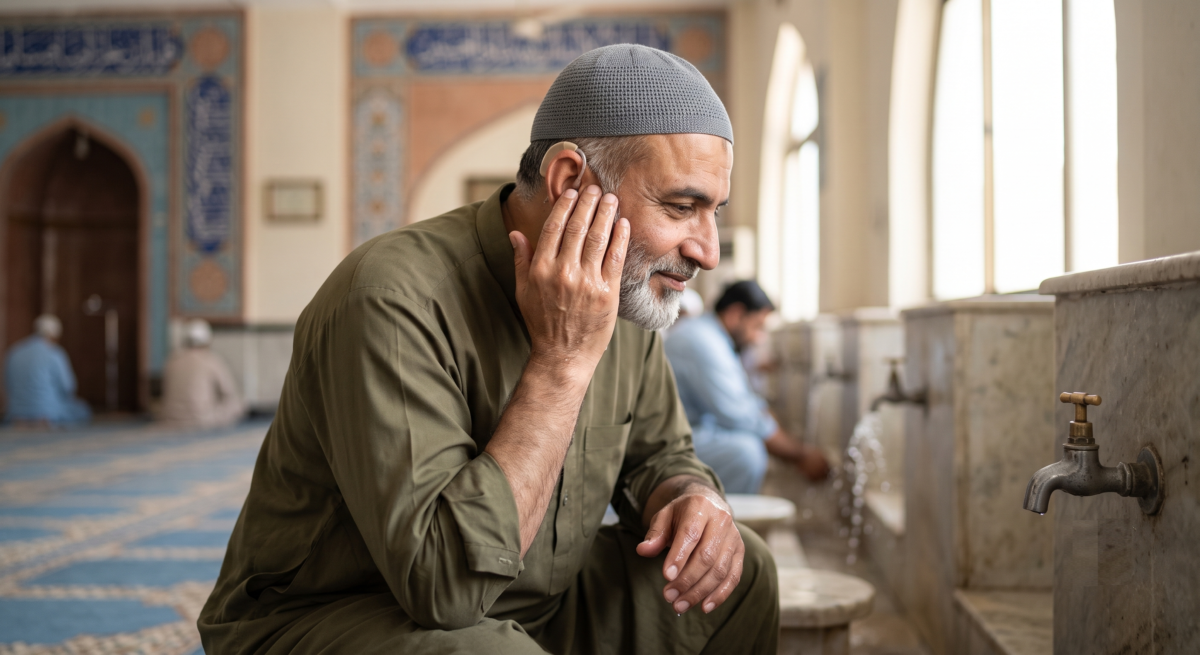
Every day, thousands of Pakistani Muslims quietly worry about a question they are almost too shy to ask their local imam: does my hearing aid stop my wuzu or my namaz from being valid? Some remove their device before every prayer just to be safe, straining to hear the imam and missing parts of the congregation. Others keep it on but pray with a nagging doubt in their heart. Very few have ever received a clear, practical answer.
This guide brings together Islamic scholarship, mainstream fiqh positions, and audiology best practices to answer the question properly, insha Allah, so you can perform wuzu and salah with confidence, protect your hearing device at the same time, and worship without unnecessary anxiety.
We are not a fatwa authority, and this article is not a substitute for asking your own imam or local mufti about your specific situation. What we can offer, as a hearing healthcare provider that fits and services hearing aids across Pakistan every day, is an honest explanation of how these devices actually work on the body, combined with the positions that respected Islamic scholars have already given on very similar questions such as earplugs, glasses, and other worn medical devices.
Quick Answer for Those in a Hurry
If you only read one paragraph, read this one.
According to the majority of scholars, including the Hanafi school followed by most Pakistani Muslims, wiping the ears during wuzu is Sunnah and recommended, not fard or obligatory. This means a hearing aid sitting in or around the ear does not invalidate your wuzu, because there is no strict requirement to remove it in the first place. During salah, wearing a hearing aid is generally treated the same way as wearing glasses, a wristwatch, or a pacemaker. It is a worn medical device, not an impurity, and it does not break your prayer. The only real precautions relate to protecting the electronics from water damage and managing feedback noise out of respect for the congregation, not religious prohibition.
Understanding Wuzu and Why the Ears Matter
Wuzu, the ritual ablution Muslims perform before salah, involves washing the face, arms, and feet, and wiping the head and ears with water. The concern for hearing aid users usually comes from one simple worry. If the ears must be wiped with wet hands, does a hearing aid sitting inside or behind the ear canal get in the way, and does that break the validity of the wuzu?
What the Fiqh Actually Says About Wiping the Ears
This is where a lot of anxiety can be put to rest immediately. According to Islamic scholars, the majority of scholars view that wiping the ears in wudu is sunnah and recommended, but is not obligatory, meaning that if a person forgets to wipe their ears, their wudu remains valid. This majority position includes the Hanafi, Shafi, and most Maliki scholars, which covers the overwhelming majority of Muslims in Pakistan.
Some scholars, particularly within the Hanbali school, hold that wiping the ears is obligatory because the ears are considered part of the head, and the Prophet Muhammad, peace be upon him, consistently practiced wiping them during wudu. Even under this stricter view, the actual method of wiping only requires touching the outer parts of the ear, not reaching inside the ear canal. As described by Islamic scholars, the insides of the ears should be wiped with the forefingers, and the outsides with the thumbs, without needing to follow every fold or contour of the cartilage.
What this means practically is that even a strict interpretation of wuzu does not require water to enter the ear canal itself, which is exactly where a hearing aid receiver or in canal device sits. A quick wipe of the visible outer ear with wet fingers, moving gently around a behind the ear device or an in the ear shell, fulfills the sunnah without needing to remove the device at all in most cases.
Do Different Hearing Aid Styles Change the Ruling?
The physical answer differs slightly by device type, though the religious ruling stays the same across all of them, since none of the styles below block water from reaching the parts of the ear that actually need to be wiped.
| Hearing Aid Type | Where It Sits | Removal Needed for Wuzu | Practical Tip |
|---|---|---|---|
| Behind the Ear (BTE) | Behind and over the top of the ear | Not required | Lift gently, wipe the outer ear, avoid soaking the device |
| Receiver in Canal (RIC) | Behind the ear with a thin wire into the canal | Not required | Wipe around the wire carefully, keep receiver dry |
| In the Ear (ITE) | Fills the outer bowl of the ear | Not required | Wipe around the shell, avoid direct water contact |
| In the Canal (ITC) and Completely in Canal (CIC) | Mostly hidden inside the canal | Not required | Wipe the visible outer ear only |
| Invisible in Canal (IIC) | Deep inside the canal, not visible | Not required | External wipe is sufficient |
If you want to understand these device categories in more depth before your next fitting, our hearing devices and aids guide breaks down each style, including which one suits different degrees of hearing loss.
Should You Actually Remove Your Hearing Aid for Wuzu?
Here is the honest, practical advice, separate from the religious ruling. You are not religiously required to remove a modern hearing aid for wuzu. However, from a device care perspective, we generally recommend removing it anyway, for a completely different reason: moisture protection.
Hearing aids are precision electronic instruments. Even models marketed as water resistant are not fully waterproof, and repeated splashing during wuzu, five times a day, can shorten the lifespan of the microphone and receiver components over months and years. So the practical middle ground most audiologists, including our team, recommend is this: remove the device before wuzu, place it somewhere dry and safe, complete your ablution as normal including wiping your ears, then put the device back in before salah begins. This protects your investment without adding any religious obligation that does not exist.
Wearing a Hearing Aid During Salah
Once wuzu is complete, the next question is whether the hearing aid can stay in during the prayer itself.
The General Ruling on Worn Medical and Assistive Devices
Islamic scholars have repeatedly addressed similar questions about items worn on or near the body during salah, such as glasses, watches, and hearing protection. On the specific topic of ear worn devices during prayer, scholars have explained that wearing an earplug or similar hearing device during salah is not something that causes harm on its own. The scholarly guidance further notes that if wearing such a device is recommended by a physician, then a person should follow that medical advice and wear it during prayer.
This same logic extends comfortably to hearing aids, which are prescribed medical devices, not decorative or unnecessary items. Prayer garments and prosthetics have long been addressed under a broader principle in fiqh: an item does not invalidate salah unless it is impure, unless it distracts you from the core pillars of prayer, or unless it physically prevents you from performing the required movements correctly. A hearing aid does none of these things.
A closely related example that Islamic scholars have already ruled on is prayer while wearing glasses. As detailed in Islamic rulings on this topic, wearing glasses made of plastic or metal frames during salah is permissible, provided the frame material is not impure. The same reasoning applies directly to a hearing aid, which is made of medical grade plastic, silicone, and electronic components, none of which are considered impure or najis in Islamic law. Fatwaqa
What About Purity of the Device Itself?
A common secondary worry is whether the hearing aid, being a manufactured object that touches the body throughout the day, needs to be considered in terms of tahara, or ritual purity. Since a hearing aid is made from plastic, silicone, and metal casing, and does not come into contact with anything impure in ordinary daily use, it is treated as a pure, tahir object, exactly like a wristwatch, spectacles, or a wallet in your pocket. There is no requirement to clean or purify it before salah unless it has visibly come into contact with an impurity, in which case normal cleaning is sufficient.
Feedback Noise and Distraction During Congregational Prayer
One practical issue that is more about etiquette than fiqh is hearing aid feedback, the whistling sound that can occur if the volume is too high or the fit is loose. This does not invalidate your salah, but it can distract worshippers standing near you in congregation. A few simple habits solve this completely:
- Have your audiologist check the fit and seal of your device regularly to prevent whistling.
- Slightly lower the volume during congregational prayer if your device allows manual adjustment.
- If your hearing aid has a telecoil or directional microphone setting, ask your audiologist whether a mosque friendly program can be added during your next tuning session.
If you experience frequent whistling or discomfort, it is often a sign that your device needs a checkup rather than a religious problem. Our team regularly performs these adjustments as part of routine audiological testing and fittings.
Common Concerns Hearing Aid Users in Pakistan Ask
Will Ghusl Damage My Hearing Aid?
Yes, ghusl involves fully wetting the head and body, so hearing aids should always be removed before ghusl, without exception, regardless of the religious ruling on wuzu. This is purely a device protection issue rather than a fiqh issue, since no scholar requires you to shower or bathe with an electronic device inserted in your ear.
Can I Wear My Hearing Aid During Tawaf or Hajj Related Rituals?
Yes, the same principles apply. A hearing aid is a medical device, not an item that is restricted during Ihram in the way that stitched clothing or fragrance is for men. If you are planning Hajj or Umrah, it is worth discussing your specific device and travel plans with your audiologist beforehand, since humidity, dust, and long days can affect battery life and device performance in Saudi Arabia.
Does the Shia Ruling on Wiping the Ears Differ?
Yes, and it is worth noting for readers following Jafari fiqh. According to Shia scholarship, wiping the ears is not considered part of wudu at all, since the Imams from the family of the Prophet held that wudu consists only of washing the face and hands and wiping the head and feet. This means the question of a hearing aid interfering with ear wiping does not even arise under this school of thought, and the wuzu focuses entirely on the head and feet wiping instead. Al-Islam
What If My Imam Gives a Different Answer?
Always follow the guidance of your own local imam or mufti for your personal situation, particularly if you have a specific health condition, a cochlear implant, or a device that behaves differently from a standard hearing aid. Fiqh questions can carry nuance based on individual circumstances, and a qualified scholar who knows your situation is always the right final authority, not a blog post.
A Note From Islamabad Hearing Center
We meet hearing aid users across Pakistan every single day, from Islamabad and Rawalpindi to Peshawar and Faisalabad, and this exact question comes up in our clinics constantly, often asked quietly, almost apologetically, at the end of an appointment. We wanted to put together an honest, well researched answer because your faith and your hearing health should never feel like they are in conflict.
If your hearing aid whistles during prayer, feels uncomfortable during wuzu, or simply needs a professional checkup, our audiologists across Pakistan are happy to help you find a device and a fit that works for your daily life, prayers included. You can browse our full range of digital hearing aid brands and styles or read more on our blog for guides on choosing the right device for your needs and budget.