If your doctor has referred your child for a BERA test, or if you have noticed something different about the way your baby or toddler responds to sound, you are likely searching for clear and trustworthy information right now. You want to understand what this test actually is, whether it is painful, what happens during the procedure, and how much it will cost you in Islamabad or anywhere else in Pakistan.
This guide answers every one of those questions. It is written by the team at Islamabad Hearing Center (IHC), Pakistan’s most advanced audiology network, which has been conducting professional hearing assessments for children and adults since 2009. By the time you finish reading, you will know exactly what to expect from the BERA test, why it matters, and where to get it done by qualified audiologists in Pakistan.
What Is the BERA Test?
BERA stands for Brainstem Evoked Response Audiometry. It is sometimes also called the ABR test, which stands for Auditory Brainstem Response. Both names refer to the same clinical procedure. The BERA test is an objective hearing assessment that measures how the auditory nerve and brainstem respond to sound. Unlike conventional hearing tests that require the patient to press a button or raise a hand when they hear a sound, the BERA test requires no voluntary response from the patient at all. This is precisely what makes it so valuable for infants, newborns, and young children who cannot participate in standard hearing tests.
The BERA test was first described scientifically by Jewett and Williston in 1971, and it has since become one of the most widely used and clinically validated hearing assessment tools in audiology worldwide. According to the American Speech-Language-Hearing Association (ASHA), the ABR/BERA test is considered the gold standard for evaluating hearing thresholds in populations that cannot be tested using conventional methods, including newborns, infants, and individuals with developmental or cognitive differences.
In Pakistan, the BERA test has become increasingly important as awareness of childhood hearing loss grows. Undetected hearing loss in a child’s early years can have a serious impact on speech development, language acquisition, cognitive growth, and social skills. The BERA test allows audiologists to identify hearing issues as early as the first few weeks of life, enabling intervention before these developmental delays can take hold.
Why Is the BERA Test Done?
Parents and doctors request the BERA test for several specific reasons, and understanding these helps you know whether your child needs it.
The most common reason is a failed newborn hearing screening. Many hospitals in Pakistan now conduct a basic Otoacoustic Emission (OAE) screening for newborns before discharge. If a baby does not pass this initial screen, a BERA test is the recommended follow-up assessment to confirm whether there is a true hearing problem or whether the initial result was a false alarm.
The second major reason is parental concern. If you have noticed that your baby does not startle at loud sounds, does not turn their head toward voices by 3 to 4 months of age, or is not babbling by 6 to 9 months, these are signs that should be taken seriously. A hearing test at this stage gives you the clinical information you need to act quickly.
The BERA test is also used for children with a family history of congenital hearing loss, children who were born prematurely, babies who experienced complications at birth such as lack of oxygen, children who have had severe jaundice or meningitis, and children who have been exposed to certain medications known to affect hearing. In all of these cases, waiting for a child to fail in school or in speech development before investigating hearing is too late.
Adults can also benefit from the BERA test. In adult patients, it is used to investigate suspected auditory nerve tumors, to evaluate unexplained dizziness or balance disorders, and to assess hearing in patients who are unable to complete standard audiometry.
How Does the BERA Test Work?
The BERA test measures the electrical activity generated by the auditory nerve and brainstem in response to sound stimuli. When a sound enters the ear, it travels through the outer and middle ear, reaches the cochlea in the inner ear, and is then converted into electrical impulses that travel along the auditory nerve to the brainstem and eventually to the brain. The BERA test records this electrical journey using electrodes placed on the surface of the scalp.
The result is a series of waveforms on a graph, each representing a specific point along the auditory pathway. Audiologists read these waveforms to determine whether sound is being processed normally at each stage, whether there is a delay or an abnormality in transmission, and what the patient’s hearing threshold is.
The entire process is completely passive. The patient does not need to do anything. The test works whether the patient is awake, asleep, or — in some cases — under light sedation. This makes it completely safe for newborns and infants.
What Happens During the BERA Test: Step by Step
Knowing exactly what will happen during your child’s appointment helps to reduce anxiety for parents and makes the session go more smoothly. Here is what you can expect at Islamabad Hearing Center when your child comes in for a BERA test.
Before the test: You will be asked to fill in a short clinical history form covering your child’s birth history, any illnesses, medications, or family history of hearing loss. The audiologist will review this information and speak with you about your concerns before beginning.
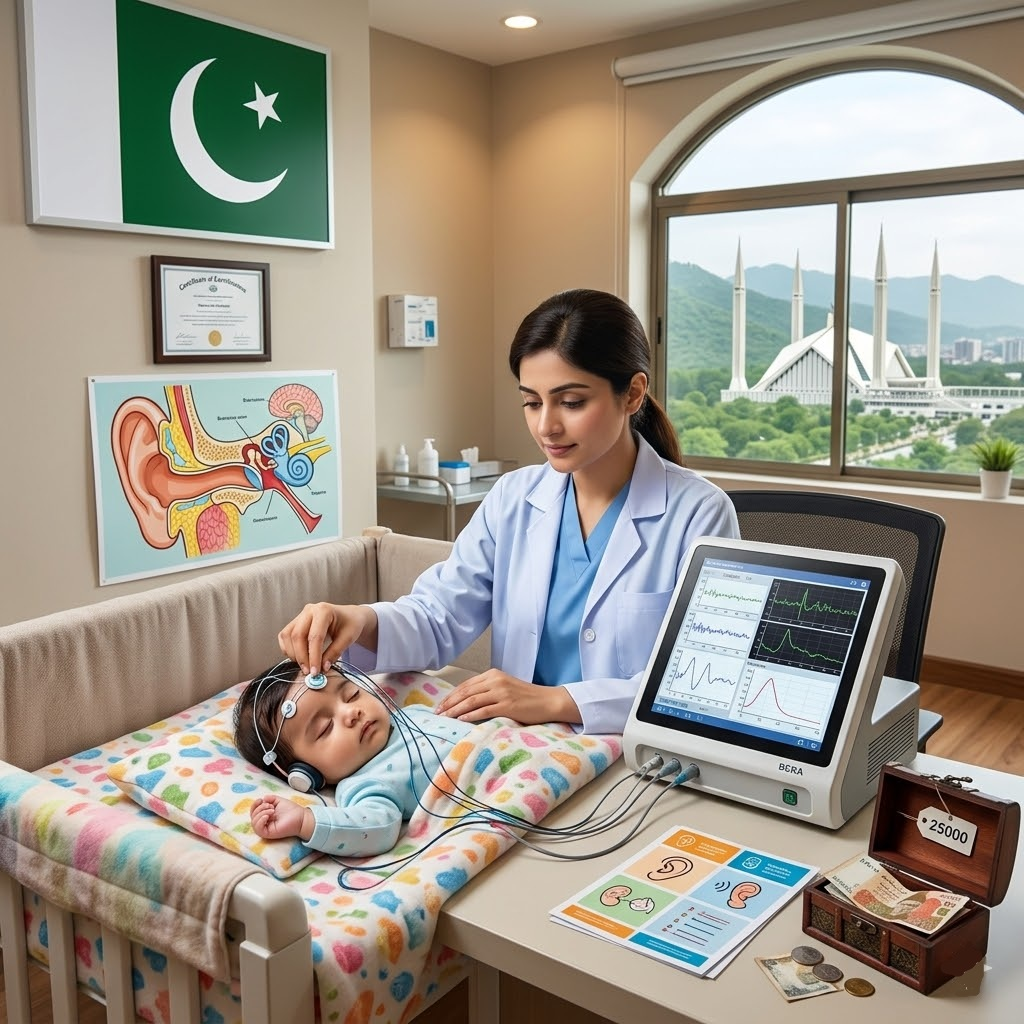
Electrode placement: Small, painless electrodes are placed on your child’s forehead, on the mastoid bone behind the ear, and on the earlobe or top of the head. These electrodes are connected to wires that lead to the BERA equipment. The electrodes do not deliver any electrical signal to your child — they only record the brain’s own electrical responses. No needles are involved.
Sound delivery: Your child is fitted with small earphones or insert phones. A series of click sounds or tone bursts are played through these earphones at various volumes and frequencies. The sounds are brief and quiet — they will not startle or distress your child.
Recording the response: The BERA equipment records the electrical responses generated by the auditory nerve and brainstem in response to each sound. The audiologist monitors the waveforms on the screen throughout the procedure.
Duration: The test typically takes between 45 minutes and 90 minutes depending on the child’s age and how cooperative they are. For sleeping infants, the test can often be completed in a single session without sedation. For older toddlers who may be more restless, the audiologist may suggest scheduling the appointment during a natural nap time or may recommend light sedation in consultation with a pediatrician.
Results: The audiologist will explain the results to you immediately after the test. You will receive a printed report of the waveforms with the audiologist’s clinical interpretation. If the results indicate any hearing loss, the audiologist will also guide you on the next steps, which may include further testing such as the ASSR Test or a referral for medical management.
Is the BERA Test Painful or Harmful?
This is the question parents ask most often, and the answer is clear: the BERA test is completely painless and non-invasive. No injections, no instruments inside the ear canal, and no electrical stimulation of any kind are involved. The electrodes simply sit on the skin surface and detect the brain’s natural electrical activity. The sounds played through the earphones are at safe listening levels, and the entire procedure carries no physical risk to your child.
The only challenge with young children is keeping them still enough for the electrodes to record clean signals. A sleeping or calm child produces the best quality results. This is why parents are often advised to keep their baby awake for a while before the appointment so the child is ready to sleep during the test, or to schedule the appointment during the child’s usual nap time.
BERA Test vs OAE Test: What Is the Difference?
Parents sometimes ask how the BERA test is different from the OAE test, which is the standard newborn hearing screen conducted in hospitals. Both tests are used for children and both are objective, but they measure different things at different levels of the auditory system.
The OAE test measures the response of the cochlear hair cells in the inner ear. It is a fast, simple test that gives a pass or refer result. It is excellent as a first-line screen but does not give information about the auditory nerve or brainstem. A child can pass an OAE test but still have auditory nerve dysfunction, a condition sometimes called auditory neuropathy.
The BERA test goes deeper into the system, measuring the function of the auditory nerve and the brainstem response. It provides detailed waveform data and can estimate hearing thresholds at different frequencies. For this reason, the BERA test is used as the confirmatory test when an OAE screen gives a refer result, and it is the test of choice for diagnosing the specific type and degree of hearing loss.
Our new born screening program at IHC includes both OAE and BERA assessments, giving families a comprehensive picture of their child’s hearing health from the very first days of life.
What Can the BERA Test Detect?
The BERA test provides clinically valuable information across several categories of hearing and neurological assessment.
It can confirm whether a hearing loss is present at all, which is particularly important in cases where standard behavioural testing is not yet possible due to a child’s age. It can identify the type of hearing loss — whether conductive (involving the outer or middle ear), sensorineural (involving the inner ear or auditory nerve), or neural (involving the auditory nerve specifically, as in auditory neuropathy spectrum disorder). It can estimate the degree of hearing loss across different pitches or frequencies. It can identify retro cochlear pathology, which refers to problems beyond the cochlea, such as auditory nerve tumors or brainstem lesions, making it relevant for adult patients too. And it can assess the integrity of the brainstem auditory pathway, which has clinical applications in monitoring patients in intensive care, during neurosurgery, or after head injuries.
For parents, the most important practical output is simply knowing whether their child’s hearing is within normal limits or whether there is a problem that requires intervention. Early identification of hearing loss allows families to access hearing aids, auditory rehabilitation, and speech therapy at the earliest possible age, which research consistently shows leads to dramatically better outcomes for speech, language, and educational development.
According to the World Health Organization, over 430 million people globally have disabling hearing loss, and early intervention remains the most effective strategy for minimizing its long-term impact on quality of life. In Pakistan, where awareness of hearing loss screening in newborns is still growing, the BERA test plays a critical role in catching problems that would otherwise go undetected for years.
BERA Test Cost in Pakistan: What to Expect in Islamabad
One of the most searched questions related to the BERA test in Pakistan is about cost. Parents want to know what they will pay before they commit to an appointment, and this is completely reasonable. Transparency in healthcare pricing builds trust and helps families plan.
The cost of the BERA test in Pakistan varies depending on the city, the facility, and the technology being used. At a well-equipped audiology center with properly calibrated equipment and qualified audiologists, the price in Islamabad typically falls in a range that reflects the clinical expertise and technology involved. Basic BERA tests at less equipped facilities may be offered at lower prices, but the quality of the waveform data and the accuracy of interpretation depends entirely on the equipment and the experience of the audiologist reading the results.
At Islamabad Hearing Center, the BERA test is conducted using advanced diagnostic equipment by certified audiologists trained in multiple countries. We believe that parents seeking answers about their child’s hearing deserve the highest standard of clinical testing, not just the cheapest available option. For the latest pricing and to book an appointment, we encourage you to call our team directly at 051 8899990 or WhatsApp us at +92 336 5784920. You can also visit our contact page to reach the branch nearest to you.
We serve patients across Islamabad, Rawalpindi, Peshawar, Faisalabad, Karachi, Multan, Sargodha, Muzaffarabad, Rawalakot, and Bagh City. If you are outside Islamabad, our branch network means you can access the same standard of BERA testing closer to home.
What Happens After the BERA Test?
The result of the BERA test shapes the next steps in your child’s care pathway. If the results are normal, it means the auditory nerve and brainstem are responding to sound within expected parameters. Normal BERA results give parents significant reassurance and rule out sensorineural hearing loss as the cause of any concerns.
If the results show a mild, moderate, or severe hearing loss, the audiologist will explain exactly what this means in practical terms and what options are available. For most forms of sensorineural hearing loss in children, digital hearing aids are the primary intervention. At IHC, we carry hearing aids from the world’s leading brands including Phonak, Signia, Widex, Oticon, and Starkey, and we provide fitting, programming, and ongoing support through our hearing aid services. For cases of profound hearing loss where hearing aids do not provide sufficient benefit, a cochlear implant evaluation may be recommended.
If the BERA results suggest auditory neuropathy spectrum disorder, a more specific pattern of intervention is required, and the audiologist will guide you through this in detail. In some cases, additional tests such as the ASSR Test or Tympanometry are conducted alongside the BERA to build a complete picture of the child’s hearing profile before deciding on a management plan.
The key message is this: whatever the result, a BERA test gives you information you can act on. Not knowing is always worse than knowing, because only with a clear diagnosis can you begin the journey toward better hearing for your child.
When Should You Book a BERA Test?
Do not wait for a formal referral if you have concerns about your child’s hearing. The earlier a hearing problem is identified and addressed, the better the outcome for the child’s speech, language, and cognitive development. The critical window for language acquisition is the first three years of life, and hearing loss that goes undetected during this period can cause delays that are much harder to reverse later.
If your newborn did not pass the hospital hearing screen, book a BERA test within the first few weeks. If your infant is three to four months old and not responding to voices or loud sounds, book a test now. If your toddler is not babbling, is not using words by 12 to 15 months, or seems to hear only when they want to, do not put off the assessment. If a family member has congenital hearing loss or your child had a difficult birth, early screening is strongly advised regardless of whether you have noticed any concerns.
You can read more about the early signs of hearing loss in children in our blog on 10 early signs of hearing loss you should never ignore, which covers the warning signals that parents across Pakistan often miss in the early years.
Frequently Asked Questions About the BERA Test in Pakistan
At what age can the BERA test be done?
The BERA test can be performed from the first days of life onwards. There is no minimum age. For newborns and very young infants, the test is typically done while the baby is in a natural sleep. For children above six months who may not sleep naturally during the test, the audiologist may coordinate with a paediatrician for light sedation if needed.
Does the BERA test require sedation?
Not always. Many infants and young children can be tested while naturally asleep without any sedation. For older toddlers or children who are difficult to settle, light sedation may be recommended by the managing paediatrician to ensure a quality recording. The decision is made case by case based on the child’s age and behaviour.
Can the BERA test give a false result?
The BERA test is highly reliable when conducted with properly calibrated equipment by an experienced audiologist. A false positive result is rare. In some cases, a second test may be recommended to confirm findings, particularly for borderline results or when the recording quality was affected by movement artifacts.
Is the BERA test available outside Islamabad in Pakistan?
Yes. Islamabad Hearing Center offers BERA testing at branches in Rawalpindi, Peshawar, Faisalabad, Karachi, Multan, Sargodha, Muzaffarabad, Rawalakot, and Bagh City. Contact us to confirm availability at your nearest branch.
What should I bring to the BERA test appointment?
Bring any previous hearing test reports if available, your child’s vaccination card for age confirmation, and any referral letter from your doctor. If your child takes regular medication, inform the audiologist before the appointment. For infants, bring feeding supplies to help settle the child to sleep during the test.
Why Choose Islamabad Hearing Center for the BERA Test?
IHC has been Pakistan’s trusted name in audiology since 2009. Our team of certified audiologists, ENT specialists, and internationally trained engineers conducts BERA testing using advanced diagnostic equipment in a child-friendly clinical environment. We understand that a parent bringing their child for a hearing test is often anxious and in need of clear, compassionate guidance, and we ensure that every family leaves with a thorough understanding of what their child’s results mean and what the next step should be.
We also understand that hearing loss does not end with a test. For children who need hearing aids, our hearing aid laboratory provides ongoing fitting, programming, earmould manufacturing, repair, and warranty support. For children with ear infections that may be affecting hearing, our team works alongside ENT specialists to address the underlying cause. For parents who want to understand more about their child’s development following a hearing diagnosis, our audiologists provide comprehensive counselling at every visit.
To book your child’s BERA test at Islamabad Hearing Center, call us on 051 8899990, WhatsApp us at +92 336 5784920, or visit our contact page to find your nearest branch.
Final Thoughts
The BERA test is one of the most important diagnostic tools available for identifying hearing loss in children early enough to make a real difference to their development. It is painless, non-invasive, highly accurate, and suitable for patients of all ages including newborns. For any parent in Pakistan who has been advised to get a BERA test for their child, or who suspects their child may have a hearing issue, acting sooner rather than later is always the right decision.
Pakistan has a growing network of qualified audiology centres, and Islamabad Hearing Center stands at the forefront of that network with the clinical expertise, the technology, and the nationwide presence to serve families wherever they are. If you are ready to book a BERA test or simply want to ask questions before committing to an appointment, our team is available and ready to help.
You can also learn more about the broader range of hearing assessments we offer by visiting our complete hearing test services page, or explore what happens after a diagnosis on our hearing aids page.
Your child’s hearing matters. The right test, at the right time, from the right team, can change everything.