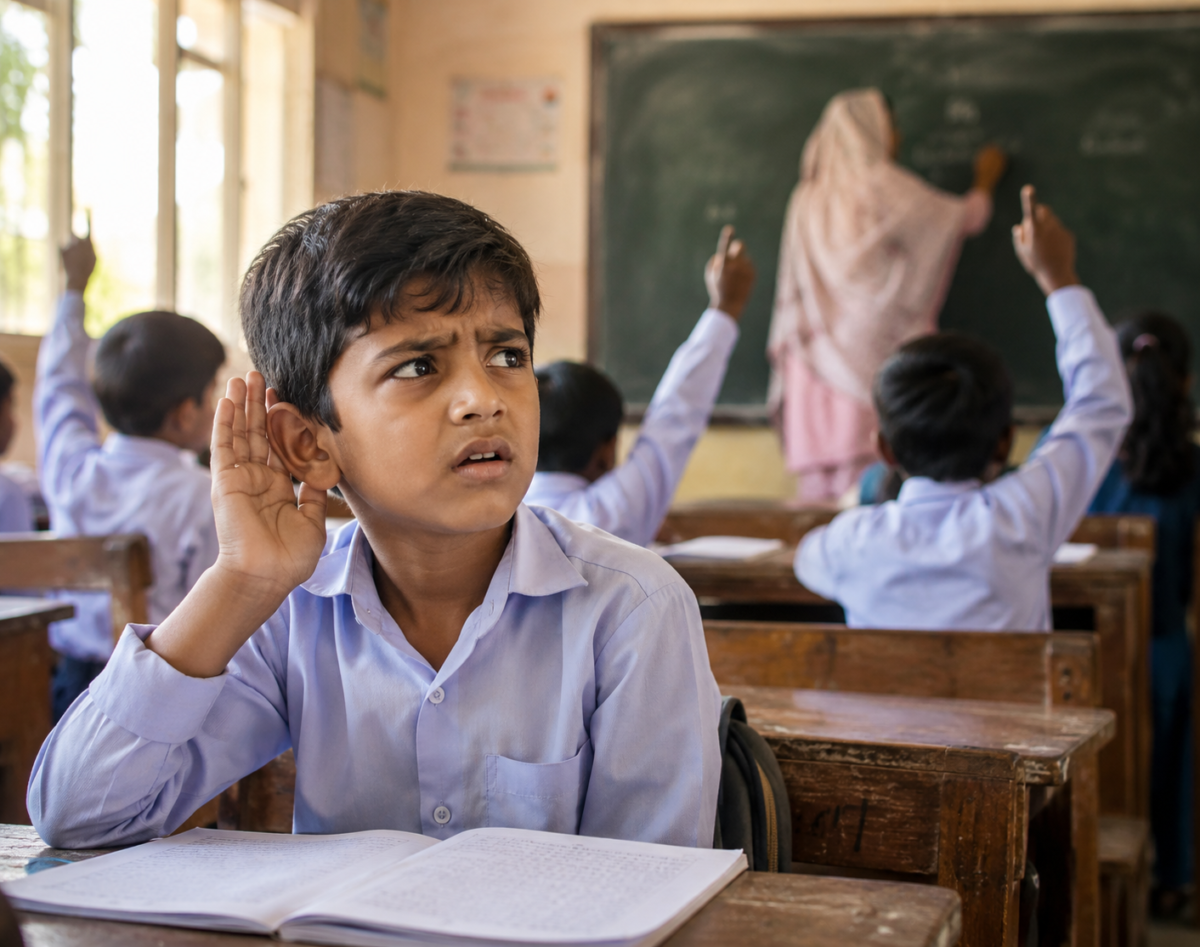
A child comes home from school with another poor report card. The teacher says he seems distracted. His mother thinks he is lazy. His father thinks he needs a stricter tutor. Nobody in the room considers the one explanation that fits perfectly with every symptom being described, that this child simply cannot hear properly, and has been quietly struggling through every single lesson for years.
This scene repeats itself in classrooms across Lahore, Karachi, Islamabad, Faisalabad, and small towns throughout Pakistan every single day. Parents spend money on tuition centers, switch schools, scold their children for not paying attention, and rarely, if ever, book a simple hearing test. Yet the research is unambiguous. Undiagnosed hearing loss is one of the most overlooked causes of academic struggle in children, and Pakistan has a rate of childhood hearing loss that is more than double the global average.
This guide explains why so many Pakistani children are falling behind for a reason nobody is checking, how to recognize the warning signs at home, and exactly what parents should do next.
The Scale of the Problem in Pakistan
Most parents assume hearing loss is rare, something that happens to a small number of children with obvious, visible conditions. The data tells a very different story.
According to research published through the World Health Organization Eastern Mediterranean Region, congenital or early onset hearing loss affects 13 out of every 1,000 newborns in Pakistan, compared with a global rate of only 4 per 1,000. Separately, a community screening study conducted in Punjab found that overall hearing loss affects roughly 7.9 percent of school aged children in Pakistan, a rate the researchers described as more than double global estimates.
Globally, the World Health Organization estimates that at least 34 million children under the age of 15 live with disabling hearing loss, and a large share of these cases go undetected for years, particularly in countries without routine screening programs.
Why Pakistan’s Numbers Are So High
Several factors specific to Pakistan contribute to this elevated risk, and understanding them helps parents recognize when their own child may be at higher risk.
- High rates of consanguineous marriage. Research on parental knowledge of childhood hearing loss in Rawalpindi points to consanguineous marriages as a significant contributing factor to the country’s elevated prevalence of congenital hearing loss, since many inherited forms of hearing loss are recessive genetic conditions.
- Absence of routine newborn hearing screening. Unlike many developed countries where every newborn is screened before leaving the hospital, WHO research on Pakistan notes that late identification of hearing impairment remains common because of the absence of widespread neonatal hearing screening, driven largely by financial constraints and limited epidemiological data collection.
- Reliance on informal home testing. The same research describes how some doctors still rely on clapping or clicking fingers near a newborn to check hearing, a method that cannot reliably detect mild or moderate hearing loss and gives parents false reassurance.
- Delayed parental recognition. The WHO study found that only 35 percent of parents in Pakistan noticed their child’s hearing impairment before 6 months of age, with many cases going unnoticed well into the second year of life or later.
How Hearing Loss Quietly Sabotages School Performance
It is worth understanding exactly how a child’s hearing connects to classroom performance, because the link is rarely obvious to parents or even teachers.
The Direct Academic Impact
The American Speech Language Hearing Association has reported that children with mild to moderate hearing loss who do not receive help are likely to fall behind their hearing peers by one to four grade levels, and that children with untreated severe hearing loss often do not progress academically beyond a third grade reading and comprehension level, regardless of their actual intelligence.
A study published in the peer reviewed journal PMC on schoolchildren with mild hearing loss found a statistically significant difference in communication and attention between children with normal hearing and those with even mild hearing loss, concluding that the condition can affect academic performance later in life if left unaddressed.
Why Even Mild Hearing Loss Matters
Many parents assume that only severe or profound hearing loss deserves attention, and that mild hearing loss is not worth worrying about. This assumption is exactly what allows the problem to persist for years. Research reviewing the educational needs of children with hearing loss has found that academic achievement for children with severe to profound hearing loss is significantly hindered relative to their peers, with roughly one third functionally illiterate by the time they finish secondary school in unsupported settings. The same body of research stresses that even mild hearing loss carries real potential for detrimental effects on education, meaning the population of children genuinely at risk academically is far larger than the number typically flagged as having a disability.
The Classroom Environment Makes It Worse
Pakistani classrooms are frequently large, noisy, and under resourced, which is precisely the environment where hearing loss does the most academic damage. A child with even mild hearing loss has to work significantly harder than classmates to follow the teacher over background chatter, fans, traffic noise, and general classroom activity. This constant strain leads to fatigue, reduced concentration, and behavior that is easily mistaken for a lack of interest or a learning disability.
The Common Misdiagnosis Trap
One of the most damaging outcomes of undiagnosed hearing loss is misdiagnosis. Children who cannot hear instructions clearly often appear inattentive, distracted, or slow to respond, symptoms that closely resemble attention deficit disorders. Parents and teachers frequently pursue behavioral or learning assessments while the actual root cause, a treatable hearing problem, is never tested for at all.
Warning Signs Every Parent Should Watch For
Hearing loss in children rarely looks like what parents expect. There is often no obvious sign that a child cannot hear, only a pattern of behavior that looks like something else entirely.
At Home
- Frequently asking “what” or asking others to repeat themselves
- Turning the television or tablet volume unusually high
- Sitting very close to speakers or screens to hear better
- Appearing to ignore instructions unless looking directly at the speaker’s face
- Speech that is delayed, unclear, or mispronounced beyond what is typical for their age
- Complaints of ear pain, ear discharge, or frequent ear infections
At School
- Consistently asking the teacher or classmates to repeat questions
- Copying from classmates rather than following spoken instructions
- Sitting quietly and appearing to participate less in class discussions
- Declining grades despite normal or above average intelligence
- Teachers reporting inattentiveness, daydreaming, or being easily distracted
- Difficulty following multi step verbal instructions
Age Based Developmental Red Flags
| Age Range | Warning Signs of Possible Hearing Loss |
|---|---|
| 0 to 6 months | No startle response to loud sounds, does not turn toward familiar voices |
| 6 to 12 months | Not babbling, does not respond to their own name |
| 1 to 2 years | Very few words compared to peers, does not follow simple one step directions |
| 3 to 5 years | Unclear or delayed speech, frequently misunderstands simple questions |
| School age (6 plus) | Falling grades, frequent requests for repetition, appears inattentive specifically in group or noisy settings |
If your child shows two or more of these signs, a professional hearing evaluation is worth pursuing rather than assuming it will resolve on its own.
What Parents Must Do Next
Step One: Do Not Wait for the School to Notice
Teachers manage large classrooms and are not trained to distinguish hearing loss from typical inattentiveness or a learning difficulty. Waiting for a teacher to raise the alarm often means years of missed development have already passed. Parents are almost always the first to notice the small, everyday clues, even if they do not immediately connect them to hearing.
Step Two: Book a Proper Audiological Hearing Test
A basic conversation test or a quick check at a general clinic is not sufficient to detect mild or moderate hearing loss. Children need a proper audiological evaluation performed by a qualified audiologist using calibrated equipment. Depending on the child’s age, this may include pure tone audiometry, otoacoustic emissions testing, or tympanometry to assess middle ear function and rule out fluid buildup or infection, a very common and treatable cause of childhood hearing loss in Pakistan. You can read more about how these audiological testing procedures work before booking an appointment.
Step Three: Understand That Many Causes Are Treatable
A significant portion of childhood hearing loss in Pakistan is conductive, meaning it is caused by fluid, wax buildup, or infection in the middle ear rather than permanent nerve damage. The Punjab based community study referenced earlier found that fully half of all identified hearing loss in the children studied was conductive in nature and amenable to either medical or surgical treatment. This is an important point for anxious parents. Many cases are not permanent and can be resolved with proper medical care once identified.
Step Four: Explore Hearing Aid Options If Needed
For children diagnosed with permanent or ongoing hearing loss, modern pediatric hearing aids are discreet, durable, and specifically designed to support speech and language development during critical school years. Our range of digital hearing aid brands includes options suitable for children, and our full hearing services overview explains the complete evaluation and fitting process from first appointment to ongoing support.
Step Five: Communicate With the School
Once a diagnosis is made, inform your child’s teachers and request simple classroom accommodations, such as preferential seating near the front of the class, facing the child directly when giving instructions, and reducing background noise where possible. These small adjustments make a measurable difference in a child’s ability to keep up academically.
A Message From Islamabad Hearing Center
As Pakistan’s leading audiology network, we see the consequences of delayed diagnosis every week, children who were labeled as slow learners, difficult, or disinterested for years, simply because nobody thought to test their hearing. The earlier hearing loss is identified, the better a child’s academic and social outcomes will be. If your child shows any of the warning signs described in this guide, we encourage you to book a proper hearing evaluation rather than waiting to see if things improve on their own. Explore our complete hearing solutions guide or visit our blog for more parent focused resources on childhood hearing health.