The first two days of a baby’s life are full of firsts first breath, first cry, first feeding, first sleep in a new world. For parents, these hours are consumed by wonder, exhaustion, and a thousand small decisions.
But hidden inside those 48 hours is a window of opportunity that most Pakistani families are not yet fully aware of a window in which a short, simple, painless set of tests can detect conditions that, left unidentified, could rob a child of normal hearing, normal development, or even a healthy life.
This is newborn screening. And it is one of the most important and underutilised tools in preventive medicine in Pakistan today.
In countries where universal newborn screening programmes are well established the United States, United Kingdom, Australia the conditions it detects are caught routinely, treated early, and managed so effectively that most affected children grow up indistinguishable from their peers. In Pakistan, awareness and availability of these tests is growing, but significant gaps remain.
This guide is for every parent who wants to understand what newborn screening tests exist, what conditions they detect, how they work, and most importantly how to make sure their baby receives them.
What Is Newborn Screening? A Clear Definition
Newborn screening is the collective term for a group of medical tests performed on a baby shortly after birth typically within 24 to 72 hours to identify conditions that are present from birth but do not yet show outward symptoms.
The defining characteristic of newborn screening is its timing. These conditions are not detectable from a physical examination alone, and many produce no obvious signs in the early weeks of life. By the time symptoms become apparent without screening delayed development, abnormal growth, hearing difficulties, metabolic crises significant and often irreversible damage may already have occurred.
Screening before symptoms appear is what makes these tests so powerful. Early detection opens a treatment window that simply does not exist once the condition has had weeks or months to affect the developing brain, nervous system, or body.
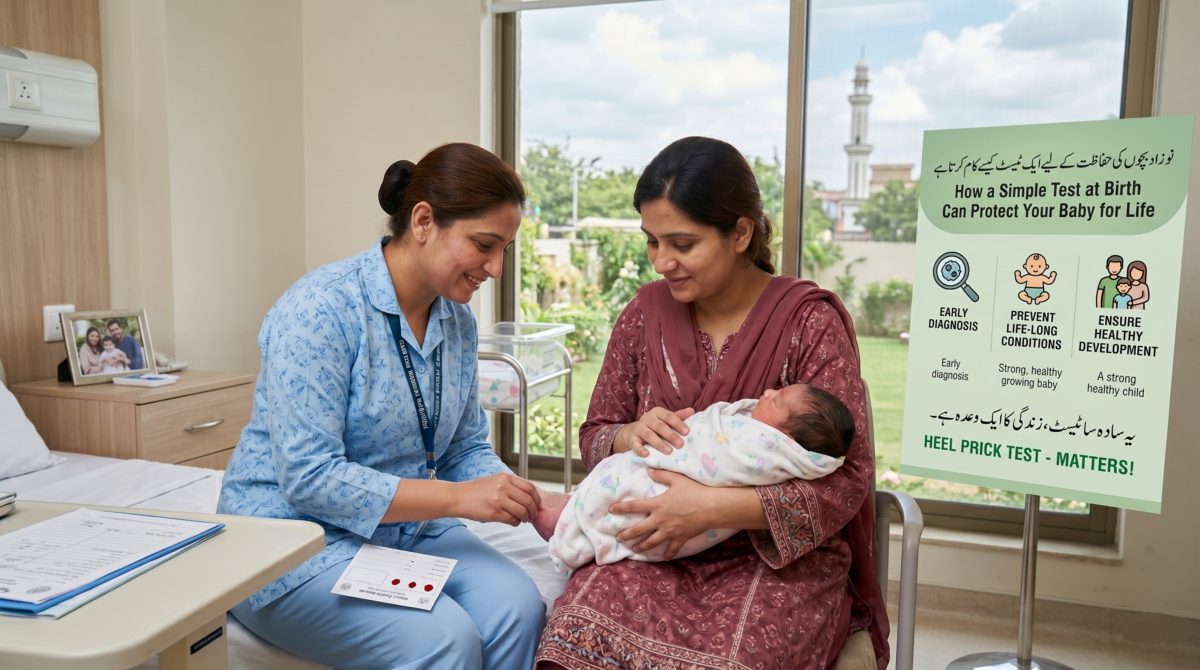
Newborn screening is not a single test it is a programme comprising two to four distinct assessments depending on the hospital and the region. In Pakistan’s more progressive hospitals, this currently includes a blood spot test (heel prick), a newborn hearing screen, and a pulse oximetry check for congenital heart disease. At Islamabad Hearing Center, newborn hearing screening is a core part of what we offer through our newborn hearing screening service.
Why Is Newborn Screening Done Right After Birth?
Timing is everything in newborn screening for two interconnected reasons.
First, many conditions are present and active from the moment of birth but have not yet caused damage. Congenital hypothyroidism, for example the most commonly detected condition in newborn screening programmes globally begins affecting a baby’s thyroid function from the earliest days of life. Left untreated, it causes severe intellectual disability and growth failure. Detected within the first two weeks and treated with a simple daily tablet, outcomes are virtually normal. The treatment is inexpensive. The damage without it is profound. The difference between these two outcomes is entirely determined by the timing of detection.
Second, the brain and auditory system develop at a pace in the first year of life that is never replicated again. For children with hearing loss, the window of maximum neuroplasticity the period in which the auditory brain most readily forms the neural connections required for language runs from birth to approximately three years of age. Every month of untreated hearing loss in this window narrows the ultimate language outcomes. Detection at birth and treatment within the first six months produces dramatically better speech and language development than detection at two or three years even when the treatment is identical.
This is why the International Joint Committee on Infant Hearing recommends a standard known as 1-3-6: screen by one month, diagnose by three months, and enrol in early intervention by six months of age. In Pakistan, achieving this timeline begins with a newborn hearing test in the hospital, ideally before the baby is discharged.
10 Conditions Detected Through Newborn Screening in Pakistan
Not every hospital in Pakistan screens for all of these conditions the panel varies by institution and by region. However, these are the conditions for which newborn screening is clinically recommended and increasingly available:
1. Congenital Hypothyroidism
The most commonly detected and most treatable condition in newborn screening worldwide. The thyroid gland fails to produce sufficient hormone from birth. Without treatment: severe intellectual disability, stunted growth, and permanent developmental delay. With daily thyroid hormone tablets started within the first two weeks: near-normal development in the vast majority of cases.
2. G6PD Deficiency
Glucose-6-phosphate dehydrogenase deficiency is among the most prevalent genetic conditions in South Asian populations, including Pakistan. It causes red blood cells to break down when exposed to certain medications, foods, or infections. Identified early, it is entirely manageable through dietary guidance and medication awareness. Unidentified, it can cause severe haemolytic crises including in newborns exposed to common medications that are preventable with simple precaution.
3. Phenylketonuria (PKU)
A metabolic disorder in which the body cannot process phenylalanine, an amino acid found in most protein-containing foods. Without screening and dietary management from the earliest weeks of life, phenylalanine accumulates and causes severe, irreversible brain damage. With early detection and a specialised low-phenylalanine diet, children with PKU develop normally and lead full lives.
4. Congenital Adrenal Hyperplasia (CAH)
A group of genetic disorders affecting the adrenal glands’ ability to produce essential hormones. In its most severe form, it causes life-threatening salt-wasting crises in the first weeks of life crises that are entirely preventable with hormone replacement therapy started immediately after detection.
5. Hearing Loss
Hearing loss is one of the most common birth conditions worldwide, affecting approximately 1-3 per 1,000 newborns in developed countries and likely higher in Pakistan due to elevated rates of consanguineous marriage and limited antenatal care access in some regions. Unlike the other conditions in this list, newborn hearing screening is not performed through a blood test it uses a quick, painless Otoacoustic Emissions (OAE) test or an ABR test that measures the inner ear’s response to sound.
Detection at birth versus detection at two or three years is not a small difference in outcome it is the difference between a child who develops normal language and one who requires years of intensive speech therapy to achieve partial communication. Early detection enables early hearing aid fitting and, where required, referral for cochlear implant evaluation.
For children who do not pass their initial newborn hearing screen, a BERA test provides definitive diagnostic information about the type and degree of hearing loss allowing the right intervention to begin as early as possible.
6. Sickle Cell Disease
Sickle cell disease causes red blood cells to form an abnormal crescent shape, leading to blockages in blood vessels, severe pain episodes, organ damage, and increased infection risk. Detected through newborn screening, children can receive prophylactic penicillin from the first months of life dramatically reducing life-threatening infections and their families can be counselled on crisis prevention.
7. Beta-Thalassaemia
Beta-thalassaemia is extremely prevalent in Pakistan, which has one of the highest rates of thalassaemia carriers globally. While the severe form (thalassaemia major) cannot be cured by early detection alone, identification at birth enables earlier transfusion therapy, iron chelation management, and most importantly genetic counselling for the family regarding future pregnancies.
8. Congenital Heart Disease (Pulse Oximetry Screen)
A simple pulse oximetry reading a small clip placed on the baby’s hand or foot that measures blood oxygen levels can detect critical congenital heart defects that may not be apparent from a physical examination. Detected early, surgical or catheter intervention can be life-saving. Missed in the newborn period, critical heart defects can cause sudden deterioration at home in the first weeks of life.
9. Cystic Fibrosis
A genetic condition affecting the lungs and digestive system. Early detection through newborn screening enables nutritional support, physiotherapy, and preventive treatment to begin before any lung damage has occurred significantly improving life expectancy and quality of life outcomes.
10. Biotinidase Deficiency and Other Metabolic Conditions
A group of rare but treatable metabolic disorders detectable through the heel prick blood spot. Without treatment, they cause seizures, developmental delay, and vision loss. With a daily biotin supplement one of the simplest and least expensive treatments in all of medicine affected children develop entirely normally.
How Is the Newborn Screening Test Performed?
The process is straightforward, quick, and causes minimal discomfort.
The heel prick blood spot test: A small amount of blood is collected from the baby’s heel a brief squeeze that causes momentary discomfort, after which babies typically settle within seconds. The blood is applied to special filter paper cards and sent to a laboratory for analysis. Results are typically available within one to two weeks.
The newborn hearing screen: A small, soft probe is placed briefly in the baby’s ear canal. The Otoacoustic Emissions test sends a quiet sound into the ear and measures the echo produced by the healthy inner ear in response. The entire test takes around five minutes per ear and is completely painless most babies sleep through it. If the initial screen does not give a clear result (which can happen due to fluid in the ear canal after birth), a repeat test or a more detailed ABR test or BERA test is arranged.
The pulse oximetry check: A small sensor is clipped to the baby’s hand or foot for a few minutes. It reads blood oxygen saturation and heart rate and requires no procedure of any kind.
The entire newborn screening programme, when performed in a well-equipped hospital, adds perhaps 20 to 30 minutes to the standard post-delivery care process and causes no harm to the baby.
Is Newborn Screening Mandatory in Pakistan?
Not universally and this is one of the most significant gaps in Pakistan’s child health system.
In most developed countries, newborn screening is a legal requirement a right enshrined in child health policy. In Pakistan, no federal law currently mandates a comprehensive newborn screening programme across all hospitals and provinces. Some private hospitals in Islamabad, Lahore, and Karachi have established their own newborn screening protocols. Government hospitals vary significantly in what is offered, with newborn hearing screening in particular being inconsistent across public sector maternity facilities.
The Pakistan Paediatric Association and audiology professional bodies have advocated strongly for a national newborn screening programme. Progress is being made but until universal screening becomes policy, the responsibility falls on parents and their healthcare providers to ensure these tests are requested and performed.
According to the World Health Organization’s report on early childhood hearing loss, countries that establish universal newborn hearing screening programmes see a dramatic reduction in the age of hearing loss diagnosis from an average of 2–3 years without screening to under 3 months with it. The cascade of developmental benefits from this single shift in detection timing is substantial.
If you are expecting a baby or have recently delivered, ask your hospital or obstetrician directly: which newborn screening tests are offered, when they are performed, and what the follow-up pathway is if a result is abnormal. If your hospital does not offer a newborn hearing screen, contact Islamabad Hearing Center our newborn hearing screening service is available for babies referred from hospitals that do not yet have this capability in-house.
What Happens If a Problem Is Found?
An abnormal screening result is not a diagnosis it is a signal for further investigation. It is important to understand this distinction clearly, because an abnormal initial screen can be caused by factors unrelated to the condition being screened for.
For blood spot results: If the laboratory flags an abnormal result, your paediatrician will arrange confirmatory testing immediately. Many initial flags are resolved by the confirmatory tests. If a condition is confirmed, specialist management begins without delay.
For hearing screens: A baby who does not pass the initial OAE hearing screen should have the test repeated, ideally within two to four weeks. Fluid in the ear canal common in the days immediately after birth is a frequent cause of initial screen failures that resolve spontaneously. If the repeat screen also does not pass, a diagnostic BERA test or ASSR test is performed to determine whether hearing loss is present and, if so, its type and degree. From this point, the pathway to hearing aids or cochlear implant evaluation can begin rapidly enough to meet the 1-3-6 guideline timelines.
Our blog on the benefits of early detection through hearing tests explains in detail how early intervention changes developmental outcomes for children with hearing loss identified in the newborn period.
The Benefits of Early Detection – Why Every Week Counts
The medical case for newborn screening is not subtle or contested. The evidence accumulated over six decades of screening programmes worldwide is consistent and clear:
Every condition detected through newborn screening that receives early treatment produces dramatically better outcomes than the same condition detected late. The gap in outcomes is not marginal in conditions like congenital hypothyroidism, PKU, and congenital hearing loss, the difference between early and late detection is the difference between a child who develops normally and one who does not.
For hearing loss specifically, the research is unambiguous. Children identified at birth and fitted with appropriate amplification before six months of age consistently achieve language development scores within the normal range for hearing children. Children identified at age two or three even with identical treatment require years of intensive speech therapy and often never fully close the language gap.
For Pakistani families, the implications are direct. The 10 early signs of hearing loss you should never ignore are visible only after a delay that newborn screening eliminates entirely. Waiting for signs is waiting for a problem that has already had months or years to develop.
How to Ask Your Hospital About Newborn Screening in Pakistan
Knowing what to ask is the first practical step:
Before delivery: Ask your obstetrician or midwife which newborn screening tests are performed at your chosen hospital. Ask specifically about the blood spot programme, the newborn hearing screen (OAE), and pulse oximetry. If any are not offered, ask how to arrange them independently.
At delivery: Remind nursing staff that you want all available newborn screening tests performed before discharge. Do not assume they will happen automatically confirm.
If your baby does not pass the hearing screen: Ask for the repeat test to be scheduled before leaving the hospital, or ask for a referral to a specialist audiology clinic for follow-up. Do not wait. Contact Islamabad Hearing Center if you need to arrange a BERA test or a diagnostic hearing evaluation outside your delivering hospital.
Document everything: Keep the screening results in your child’s health records. If you change paediatricians or move to a different city, these records travel with your child and prevent gaps in follow-up care.
Frequently Asked Questions
What is newborn screening and what does it test for in Pakistan?
Newborn screening is a group of safe, painless tests done within 72 hours of birth to detect serious but treatable conditions before symptoms appear. In Pakistan, commonly available tests include a blood spot (heel prick) for metabolic and genetic conditions like congenital hypothyroidism, G6PD deficiency, and PKU; a hearing screen using Otoacoustic Emissions; and a pulse oximetry check for congenital heart disease.
Is the newborn screening test painful for babies?
The heel prick causes a brief moment of discomfort equivalent to a light squeeze from which babies settle within seconds. The hearing screen and pulse oximetry check are completely painless and non-invasive. Most babies sleep through the hearing test. There is no lasting discomfort from any component of the standard newborn screening programme.
Is newborn screening mandatory in Pakistan?
No federal law currently mandates comprehensive newborn screening across all Pakistani provinces and hospitals. However, it is strongly recommended by the Pakistan Paediatric Association and international health bodies. Private hospitals in major cities increasingly offer it as standard. Parents should proactively request all available screening tests from their delivering hospital.
What happens if my baby does not pass the newborn hearing screen?
A screen failure does not confirm hearing loss it means further testing is needed. Fluid in the ear canal, which is common immediately after birth, frequently causes a screen failure that resolves with a repeat test two to four weeks later. If the repeat screen also fails, a diagnostic BERA test or ABR test is arranged to determine whether hearing loss is present and what form it takes.
Which conditions can newborn screening detect that parents most commonly miss?
Congenital hypothyroidism and G6PD deficiency are the most commonly detected conditions that parents would have no way of identifying without screening they cause no visible symptoms in the newborn period. Hearing loss is the most common birth condition overall, and is easily missed because babies with hearing loss behave normally in most respects during the early weeks of life.
Where can I get a newborn hearing screening in Islamabad?
Islamabad Hearing Center provides newborn hearing screening for babies referred from hospitals that do not perform the test in-house, as well as for families who wish to have their newborn’s hearing assessed independently. Contact us through our newborn screening page or contact us directly to arrange an appointment.
Prevention Is the Most Powerful Medicine Available
The conditions that newborn screening detects share a common characteristic: they are present from birth, they are largely invisible in the early weeks, and they are far more treatable when caught early than when caught late.
For Pakistani families, the message is simple. Ask for these tests. Insist on the hearing screen before your baby is discharged. If your hospital does not offer it, arrange it independently. The tests take minutes. The conditions they find, if left undetected, take years sometimes decades to manage. The investment of those minutes is among the most consequential health decisions a parent can make.
If your baby has not had a newborn hearing screen, or if you have concerns about your young child’s hearing development at any age, Islamabad Hearing Center is here to help. Our certified audiologists conduct newborn hearing screening, BERA diagnostic tests, and full paediatric audiology assessments all in a child-friendly, supportive environment.
Book a newborn hearing screen in Islamabad or learn more about our hearing tests for babies and children to take the first step today.