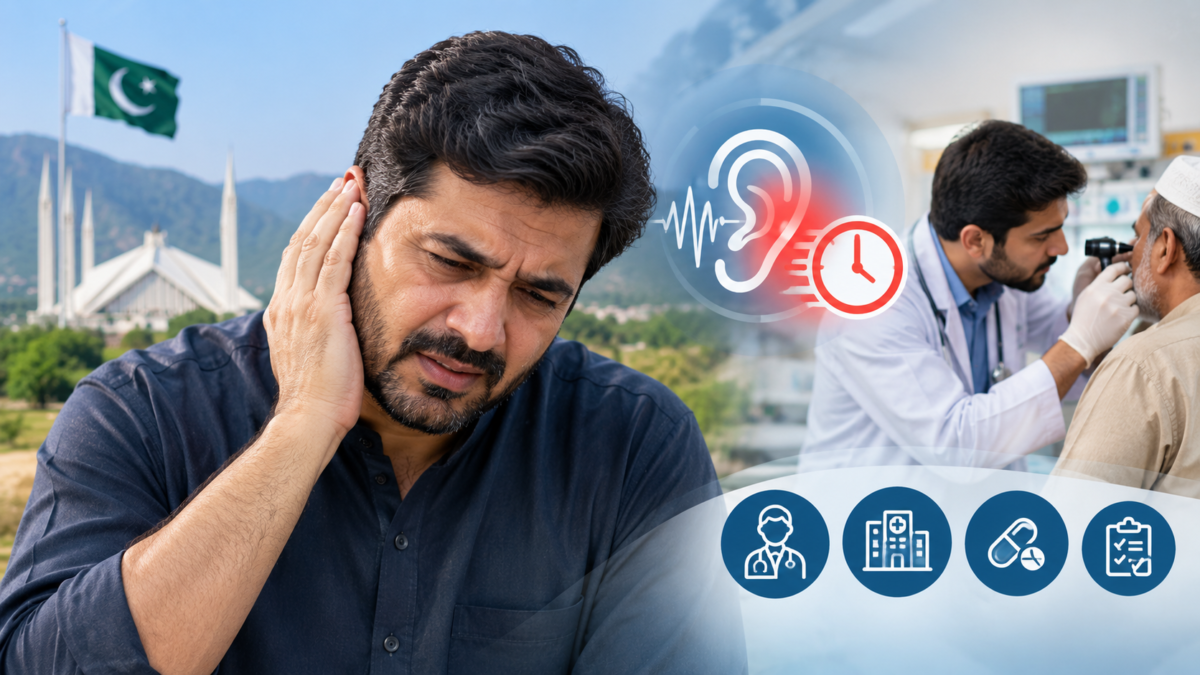
You wake up one morning and can’t hear properly.
Not the gradual fading you’ve experienced before. Not age-related decline. Not workplace noise damage.
Complete or near-complete hearing loss. Overnight. Without warning.
Your heart races. You’re panicking. You try the other ear. Same problem. Suddenly the world is muffled, distant, terrifying.
This is sudden hearing loss. And it’s a genuine medical emergency.
In Pakistan, sudden hearing loss often goes unrecognized as the emergency it is. People delay seeking treatment, thinking “it will come back on its own” or “maybe it’s just wax in my ear.”
Every hour you delay costs you chances of recovery.
This guide tells you exactly what sudden hearing loss is, why it matters, what to do in the first critical hours, where to go in Pakistan, what treatment options exist, and most importantly—why speed is literally the difference between recovering your hearing and living with permanent loss.
If this is happening to you RIGHT NOW, read Section 3 first, then call your hospital. Don’t waste time.
Section 1: Understanding Sudden Hearing Loss – Medical Facts
1.1 What Is Sudden Hearing Loss (Medical Definition)
Sudden Sensorineural Hearing Loss (SSHL) is a rapid loss of hearing that occurs over hours to days, typically affecting one ear.
Medical Definition: A loss of 30 decibels or more across three consecutive frequencies occurring over 72 hours or less.
In Plain Terms: You lose significant hearing suddenly, affecting your ability to hear speech, sounds, or both. It happens fast—often within a single day.
1.2 Types of Sudden Hearing Loss
Type 1: Complete Sudden Deafness
- Total hearing loss in one ear
- Happens within hours
- Most alarming
- Needs immediate emergency care
- Recovery depends on speed of treatment
Type 2: Partial Sudden Hearing Loss
- Significant but not complete loss
- Still disabling
- Still requires emergency treatment
- Often overlooked as “not serious enough”
- Still time-sensitive for recovery
Type 3: Progressive Sudden Hearing Loss
- Worsens over 2-3 days
- Might start mild, becomes severe
- People delay seeking care (“maybe it’s temporary”)
- Actually requires FASTER treatment
- Often worst outcomes
1.3 Affected Frequency Ranges
Sudden hearing loss typically affects:
High-Frequency Loss (Most Common):
- Affects speech clarity
- Makes voices sound muffled
- Difficulty understanding people
- Especially problematic for phone calls
Low-Frequency Loss:
- Affects bass sounds
- Music sounds strange
- Less common
- Often indicates specific causes
Flat Loss (Across All Frequencies):
- Hardest type
- Affects everything equally
- Worst prognosis for recovery
- Most urgent for treatment
Section 2: Why Sudden Hearing Loss Is An Emergency
2.1 The Time-Sensitive Recovery Window
The Critical 2-Week Window:
Medical research shows that sudden hearing loss recovery depends almost entirely on how quickly you seek treatment:
First 24 Hours (CRITICAL):
- Recovery rate with immediate treatment: 60-70%
- Wait 24 hours → Recovery rate drops to 50-60%
- This is THE most critical period
First 1-2 Weeks (URGENT):
- Recovery rate: 40-50% with treatment
- Every day of delay = reduced chances
- After 2 weeks: chances drop significantly
After 2 Weeks (LATE):
- Recovery rate: 20-30%
- Permanent damage likely
- Treatment less effective
- Should still try, but window closing
After 1 Month (CLOSED):
- Recovery rate: Less than 10%
- Hearing loss often becomes permanent
- Treatment rarely reverses loss
This is why speed matters more than any other factor.
2.2 Why Your Ears Can’t Wait
The Biological Reality:
Your inner ear contains 15,000 hair cells responsible for hearing. When sudden hearing loss occurs, these cells are damaged or dying.
Hour 1-6: Cells can potentially recover with proper treatment Hour 6-24: Cell recovery becomes harder but still possible Hour 24-48: Permanent damage begins accelerating Hour 48-72: Significant cell death occurring After 72 Hours: Damage largely permanent
2.3 Why Many Cases Worsen Without Treatment
Without proper medical intervention, sudden hearing loss often:
- Worsens progressively
- Becomes permanent
- Develops complications (vertigo, tinnitus)
- Creates psychological trauma
- Requires permanent hearing aids
- Affects entire life quality
With immediate treatment, many cases resolve completely or significantly improve.
Section 3: IMMEDIATE ACTION STEPS – DO THIS NOW
IF YOU’RE EXPERIENCING SUDDEN HEARING LOSS RIGHT NOW:
STOP reading this. Do these steps IMMEDIATELY:
Step 1: CALL YOUR NEAREST HOSPITAL (Next 10 Minutes)
In Islamabad:
PIMS (Pakistan Institute of Medical Sciences)
📞 051-9261170 / 051-9260170
Emergency: 051-9261701

Holy Family Hospital
📞 051-9247200
Emergency: 051-9247212
In Karachi:
Aga Khan University Hospital
📞 021-34864808
Emergency: 021-34930051

Liaquat National Hospital
📞 021-34314000
Emergency: 021-34314240
In Lahore:
Mayo Hospital
📞 042-37240240
Emergency: 042-37241234

Services Hospital
📞 042-99231300
Emergency: 042-99231555
Tell them: “I have sudden complete/partial hearing loss in one ear. It started [time]. I need emergency evaluation.”
Step 2: Get to Hospital ASAP (Next 30 Minutes)
- Don’t drive yourself if hearing loss affects balance
- Take a taxi, friend, or ambulance
- Bring ID and insurance documents
- Bring list of any medications you take
- Tell hospital: “SUDDEN HEARING LOSS – EMERGENCY”
Step 3: At Hospital – What to Expect
They will likely:
- Take your history (when it started, any trauma, recent illness)
- Do basic hearing test
- Check for physical cause (wax, infection)
- Likely order audiometry (complete hearing test)
- Possibly order imaging (MRI or CT scan)
- Start you on medication (usually corticosteroids)
This usually takes 1-3 hours.
Step 4: Don’t Delay – Admit Yourself if Recommended
Some hospitals recommend 3-5 day admission with:
- Multiple medications
- Bed rest
- Hyperbaric oxygen therapy (in some hospitals)
- Daily audiometry to track progress
Do this if offered. Recovery rates are significantly better with intensive treatment.
Step 5: After Initial Treatment – Follow-Up
- You’ll need audiological follow-up in 3-5 days
- Additional follow-up at 2 weeks
- Long-term monitoring for 3-6 months
- May need multiple courses of treatment
Don’t think “one dose and I’m done.” Recovery takes time and continued monitoring.
Section 4: Understanding the Causes – Why It Happens
4.1 Medical Causes of Sudden Hearing Loss
Viral Infections (Most Common – 30-40% of cases):
- Viral labyrinthitis
- Measles virus
- Mumps
- Influenza
- COVID-19 (emerging cause in Pakistan)
- Other respiratory viruses
Circulatory Problems (15-20% of cases):
- Sudden blood clot to inner ear
- Bleeding into inner ear
- Reduced blood flow from heart problems
- Stroke affecting hearing center
Inner Ear Disorders (10-15% of cases):
- Ménière’s disease
- Labyrinthitis
- Perilymphatic fistula
Autoimmune Conditions (5-10% of cases):
- Autoimmune inner ear disease
- Systemic lupus erythematosus (SLE)
- Rheumatoid arthritis affecting inner ear
Trauma (5-10% of cases):
- Head injury
- Barotrauma (pressure changes)
- Acoustic trauma (loud explosion)
Idiopathic (30-50% of cases):
- No cause found
- Despite extensive testing
- Likely viral or vascular
- Still responds to treatment
4.2 Risk Factors in Pakistan Context
Environmental Factors:
- Industrial areas with noise pollution
- Construction sites
- Factory workers (textile, manufacturing)
- Traffic congestion in major cities
- Loud music venues
Healthcare Factors:
- Delayed access to medical care
- Incomplete or delayed antibiotic treatment (infections progress)
- Uncontrolled diabetes affecting circulation
- Untreated high blood pressure
Workplace Hazards:
- Mining operations
- Steel mills
- Textile factories
- Foundries
- Construction work
Section 5: Hospital vs Emergency Room – Where to Go in Pakistan
5.1 Should I Go to Emergency Room or General Hospital?
GO TO EMERGENCY ROOM IF:
- Complete hearing loss (complete deafness in one ear)
- Severe vertigo with hearing loss
- Recent head trauma
- Bleeding from ear
- Severe ear pain
- Sudden hearing loss with other neurological symptoms
Hospital Emergency services handle urgent stabilization and initial diagnosis.
GO TO ENT DEPARTMENT/AUDIOLOGIST IF:
- Partial hearing loss
- No accompanying emergency symptoms
- Can be seen within 24 hours
- More specialized hearing evaluation
ENT specialists provide better long-term hearing assessment.
Best Option in Pakistan: Go to hospital emergency FIRST for initial evaluation. They’ll refer you to ENT if appropriate. Don’t waste time trying to figure out the “best” place—get medical evaluation IMMEDIATELY.
5.2 What Testing Happens
Initial Evaluation (1-2 hours):
- History and physical exam
- Simple hearing check
- Otoscopy (looking in ear)
- Check for obvious causes
Audiometry (1-2 hours):
- Complete hearing test
- Determines degree of loss
- Identifies which frequencies affected
- Guides treatment decisions
Imaging (1-3 hours if ordered):
- MRI scan (often done)
- CT scan (if MRI unavailable)
- Looking for tumors, stroke, other causes
- Usually delayed 24-48 hours (not emergency)
Tests for Cause (Takes days):
- Blood tests for infections, autoimmune
- Allergy testing
- Sometimes additional imaging
Total time: Usually 4-8 hours for initial emergency evaluation
Section 6: Treatment Options in Pakistan
6.1 Corticosteroid Therapy (First-Line Treatment)
Most Effective Treatment for Sudden Hearing Loss
How It Works: Reduces inflammation in inner ear, allowing hair cells to recover.
Administration:
- Oral tablets (most common in Pakistan)
- Intravenous (in hospital settings)
- Intratympanic injection (into middle ear – specialized)
Typical Course:
- High dose for 1-2 weeks
- Then gradual taper over 2-3 weeks
- Total treatment: 3-4 weeks
Effectiveness:
- Started within 24 hours: 60-70% recovery
- Started within 1 week: 40-50% recovery
- Started after 2 weeks: 20-30% recovery
Side Effects (Usually Mild):
- Increased appetite
- Sleep disturbance
- Mild mood changes
- Stomach upset (take with food)
Cost in Pakistan: PKR 5,000-15,000 for complete course
6.2 Hyperbaric Oxygen Therapy (HBOT)
Available in Select Hospitals in Pakistan
How It Works: High-pressure oxygen increases blood flow to inner ear, helps damaged cells recover.
Effectiveness:
- Most effective when combined with steroids
- Success rates: 50-70% when started within 2 weeks
- Takes 20-30 sessions
Availability in Pakistan:
- PIMS (Islamabad)
- Some private hospitals in Karachi and Lahore
- Limited availability in smaller cities
Cost: PKR 50,000-200,000 depending on number of sessions
Duration: 2-3 weeks of daily treatments
6.3 Other Treatment Options
Vasodilators (Blood Flow Improvers):
- Help circulation to inner ear
- Often given alongside steroids
- Cost: PKR 5,000-10,000
Diuretics:
- Reduce inner ear fluid pressure
- Used in certain types of sudden loss
- Cost: PKR 2,000-5,000
Antivirals:
- If viral infection suspected
- Cost: PKR 10,000-30,000
Combination Therapy (Most Effective):
- Steroids + vasodilators + HBOT
- 65-75% recovery rates
- Used for severe cases
- Total cost: PKR 60,000-250,000
6.4 Recovery Timeline – What to Expect
Week 1-2:
- Initial treatment started
- Slight improvement possible
- Hearing tests repeated
- Adjustments to medication
Week 2-4:
- More noticeable improvement likely
- Medication being tapered
- Continue full rest
- Avoid loud sounds
Month 2:
- Continued gradual improvement
- Follow-up audiometry
- Return to normal activities
- Long-term monitoring begins
Month 3-6:
- Most recovery occurs by 3 months
- Some late improvement possible
- Final hearing assessment
- Permanent hearing aid fitting if needed
Section 7: Management During Recovery
7.1 Things You MUST Do
Complete Rest (First 2-3 Weeks):
- Minimize activity
- Sleep 8-10 hours daily
- Reduce stress
- No strenuous exercise
- Allow body to focus on healing
Avoid Loud Sounds:
- Protect remaining hearing
- Avoid concerts, crowds
- Keep environment quiet
- Use earplugs in noisy situations
- Prevent additional damage
Medication Compliance:
- Take every dose as prescribed
- Don’t skip or reduce doses
- Take with food if stomach sensitive
- Report side effects immediately
- Don’t stop abruptly
Attend All Follow-Ups:
- Audiometry at 3-5 days
- Follow-up at 2 weeks
- Follow-up at 1 month
- Final assessment at 3 months
- Each shows progress and guides treatment
Emotional Support:
- This is traumatic—seek support
- Talk to family
- Join support groups (online in Pakistan)
- Consider counseling if depression develops
- Remember: recovery is possible
7.2 Things You MUST NOT Do
❌ Don’t assume it will come back on its own
❌ Don’t wait “to see if it improves”
❌ Don’t stop medication because you feel better
❌ Don’t expose yourself to loud sounds
❌ Don’t miss follow-up appointments
❌ Don’t panic excessively (stress delays recovery)
❌ Don’t delay treatment hoping for miracle
❌ Don’t use ear drops without medical approval
❌ Don’t try “home remedies” instead of medical care
❌ Don’t ignore medication side effects
Section 8: Recovery Possibilities – What’s Realistic?
8.1 The Recovery Statistics
With Treatment Within 24 Hours:
- 60-70% recover completely or near-completely
- 15-20% recover partially (usable hearing)
- 10-15% have limited recovery
- 5-10% no recovery
With Treatment Within 1 Week:
- 40-50% recover well
- 20-30% recover partially
- 15-20% limited recovery
- 10-15% no recovery
With Treatment After 1 Month:
- 20-30% recover partially
- 30-40% limited recovery
- 30-50% permanent loss
8.2 Factors Affecting Recovery
Better Recovery Chances With:
✅ Younger age (better healing)
✅ Partial loss (worse if complete)
✅ Treated within 2 weeks
✅ No other medical conditions
✅ Good blood circulation
✅ Rapid treatment initiation
✅ Compliance with medication
✅ Low stress levels
✅ Viral cause (often recovers)
Worse Recovery Chances With:
❌ Older age (healing slower)
❌ Complete hearing loss
❌ Delayed treatment (weeks or months)
❌ Diabetes, heart disease, high blood pressure
❌ Poor circulation
❌ Idiopathic (no cause found)
❌ Flat frequency loss (all frequencies)
❌ High stress, depression
❌ Poor medication compliance
Section 9: If Hearing Doesn’t Fully Return
9.1 Permanent Hearing Loss Management
If recovery is incomplete, you’ll need:
Hearing Aids:
- Often recommended 3+ months post-event
- Help compensate for permanent loss
- Allow normal communication
- Various options available
- Cost varies PKR 80,000-500,000+
Counseling:
- Adjustment to hearing loss
- Emotional recovery
- Coping strategies
- Rebuilding confidence
Support Groups:
- Connect with others
- Learn adaptation strategies
- Reduce isolation
- Share experiences
Vocational Rehab (if job-related):
- Workplace accommodation
- Job modification
- Retraining if needed
9.2 Preventing Future Hearing Loss
Protect Your Remaining Hearing:
- Avoid loud sounds
- Use earplugs in noise
- Keep volume low on devices
- Regular hearing checks
- Manage health conditions
- Reduce stress
- Exercise regularly
- Eat healthy diet
Many people with one-sided sudden loss want to protect other ear.
Section 10: Real Cases – Sudden Hearing Loss in Pakistan
Case Study 1: Asad – Viral Labyrinthitis
The Emergency: Asad, 42, woke up unable to hear his left ear. Previous evening seemed fine. Morning brought complete silence on that side.
Panic Set In: He thought he was dying. His family panicked. He waited 6 hours before going to hospital, thinking “maybe it’ll come back.”
At Hospital: Diagnosed with viral labyrinthitis. Complete hearing loss. Started on high-dose steroids and admitted.
Treatment:
- 5-day hospital admission
- Daily steroids, vasodilators
- HBOT sessions
- Multiple audiometry tests
- Strict rest, no activity
Recovery:
- By day 3: Slight improvement
- By week 2: 50% hearing returned
- By week 4: 75% hearing returned
- By month 3: 95% hearing returned
Lesson: Quick action + aggressive treatment = near-complete recovery
Case Study 2: Fatima – Idiopathic Sudden Loss
The Situation: Fatima, 55, noticed gradual loss over 2-3 days. Thought it was ear wax. Delayed going to hospital.
Delayed Treatment Consequence: By day 4 of symptoms, she finally sought medical care. Already 4 days past the critical window.
At Hospital: Complete hearing loss in right ear. No obvious cause. Imaging normal. Started treatment on day 5.
Treatment:
- 3-week steroid course
- Vasodilators
- No HBOT available (not in her city)
- Outpatient treatment
Recovery:
- By week 2: 20% hearing returned
- By month 2: 30% hearing returned
- By month 3: Remained at 30%
- Permanent loss: 70%
Lesson: Delay significantly reduces recovery chances. She needed to seek help within 24-48 hours.
Current Status: Using hearing aid, functions well, but regrets delay.
Case Study 3: Ali – Acoustic Trauma (Loud Sound)
The Emergency: Ali, 28, heard a loud explosion at construction site. Immediate complete deafness in one ear.
Immediate Action: Site supervisor called ambulance. Ali reached hospital within 45 minutes.
At Hospital: Acoustic trauma diagnosed. Barotrauma to inner ear. Treated as emergency.
Treatment:
- Immediate admission
- High-dose steroids
- HBOT was available
- 10 sessions HBOT
- 3-week treatment course
Recovery:
- By day 3: 30% hearing returned
- By week 2: 60% hearing returned
- By month 1: 85% hearing returned
- By month 3: 95% hearing returned
Lesson: Immediate hospital care + aggressive treatment + HBOT = excellent recovery
Section 11: FAQ – Sudden Hearing Loss Questions
Q1: Is sudden hearing loss always permanent?
A: No. If treated within 2 weeks, 40-50% recover completely or significantly. Even with delayed treatment, 20-30% show partial recovery. Speed and treatment intensity matter enormously.
Q2: Should I go to regular hospital or private hospital?
A: Go to whichever you can reach FASTEST. Time matters more than hospital choice. Major public hospitals in Islamabad, Karachi, Lahore have good ENT services. Private hospitals often faster but more expensive.
Q3: Will I definitely need hearing aids?
A: Not necessarily. Many people recover good hearing with treatment. Only if hearing doesn’t return to functional levels (usually after 3 months) would hearing aids be considered.
Q4: How much will treatment cost?
A:
- Basic course (steroids only): PKR 10,000-20,000
- With HBOT: PKR 60,000-250,000
- Hospital admission (3-5 days): PKR 50,000-150,000
- Total: PKR 50,000-400,000 depending on treatment intensity
- Insurance often covers hospital costs
Q5: Can I go to work while treating sudden hearing loss?
A: No. Treatment requires rest—physical and mental. Taking time off work is crucial for recovery. Most people need 2-4 weeks away from work.
Q6: What if I can’t afford treatment?
A: Don’t let cost prevent seeking care. Government hospitals in Pakistan provide treatment at affordable rates. PIMS, Mayo, Services Hospital all have good ENT departments with reduced costs for low-income patients.
Q7: Why is one ear more affected than the other?
A: Sudden hearing loss typically affects one ear because the inner ear problem (viral, vascular, etc.) is localized to that side. Bilateral (both ears) sudden loss is rare and indicates more serious systemic condition.
Q8: Can stress cause sudden hearing loss?
A: Stress doesn’t directly cause sudden hearing loss, but extreme stress can trigger viral infections or vascular problems that lead to sudden loss. Manage stress to prevent complications.
Q9: Is sudden hearing loss ever an emergency you go to ER for?
A: Yes. Complete hearing loss in one ear = medical emergency requiring immediate hospital evaluation. Don’t wait. Go immediately.
Q10: Can I recover hearing without treatment?
A: Unlikely. Spontaneous recovery happens in only 5-10% of untreated cases. Treatment dramatically increases recovery chances. Don’t rely on spontaneous improvement—seek immediate medical care.
Section 12: Action Plan – What to Do Today
IF YOU HAVE SUDDEN HEARING LOSS RIGHT NOW:
IMMEDIATE (Next 30 Minutes):
- Call nearest hospital emergency
- Get to hospital NOW
- Tell them: “Sudden hearing loss – emergency”
- Do NOT wait to see if it improves
- Do NOT drive yourself if dizzy
AT HOSPITAL (First 2-4 Hours):
- Get initial evaluation
- Start treatment (likely steroids)
- Get admitted if recommended
- Get audiometry scheduled
FIRST 24 HOURS:
- Complete medications as prescribed
- Rest completely
- Avoid loud sounds
- Follow all hospital instructions
- Schedule follow-up tests
FIRST WEEK:
- Take all medications
- Attend follow-up appointments
- Report any changes
- Comply with bed rest
- Consider HBOT if available
ONGOING (Month 1-3):
- Monthly audiometry tests
- Continued follow-ups
- Monitor recovery progress
- Plan next steps based on recovery
- Arrange hearing aids if needed by month 3
IF SOMEONE ELSE HAS SUDDEN HEARING LOSS:
Help them by:
- Taking them to hospital immediately
- Staying calm (they’re frightened)
- Supporting them during treatment
- Ensuring medication compliance
- Attending appointments with them
- Providing emotional support
- Helping arrange time off work
- Researching support resources
Section 13: Resources in Pakistan
Major Hospitals with ENT Emergency Services
Islamabad:
- PIMS (Poly Clinic 3rd Floor – ENT)
- Holy Family Hospital (Emergency Department)
- Shifa International (Emergency Department)
Karachi:
- Aga Khan University Hospital (Emergency)
- Liaquat National Hospital (Emergency)
- Sindh Institute of Urology & Transplantation (SIUT – ENT)
Lahore:
- Mayo Hospital (Emergency ENT)
- Services Hospital (Emergency ENT)
- Allama Iqbal Medical College (Teaching Hospital)
Peshawar:
- Khyber Teaching Hospital
- Lady Reading Hospital
Multan:
- Nishtar Hospital
Audiometry Services
After Emergency Treatment, you’ll need follow-up audiometry:
- Most major hospitals have audiology departments
- Private audiology centers in major cities
- Islamabad Hearing Center (comprehensive testing available)
Sudden hearing loss is terrifying. It’s sudden, unexpected, and disorienting. Your instinct might be to panic or wait and hope it improves on its own.
Don’t.
Sudden hearing loss is a medical emergency where time literally determines outcomes.
The difference between seeking treatment within 24 hours and waiting a week can be the difference between recovering 95% of your hearing and living with permanent 70% loss.
This isn’t exaggeration. This is medical fact.
Every hour you delay reduces your recovery chances. Every hour costs you potential hearing recovery.
If You Have Sudden Hearing Loss Right Now:
Stop reading. Call your nearest hospital. Go immediately. Don’t wait. Don’t second-guess. Don’t hope it improves on its own.
Your hearing depends on the next 24 hours.
If You Suspect Sudden Hearing Loss:
Treat it like the emergency it is. Get medical evaluation today. Not tomorrow. Not “when you have time.” Today.
Schedule Emergency Hearing Assessment Today
📞 Call: 051-8899990
📱 WhatsApp: +92 336 5784920
📧 Email: info@ihchearing.com
Available 24/7 for sudden hearing loss consultations