Categories
Hearing Treatment Cochlear Implant

Why Many Pakistanis Delay Hearing Treatment: Cultural & Social Reasons

Hearing loss is often overlooked in Pakistan, despite affecting millions of people across all age groups. Many individuals do not seek treatment promptly, even when early intervention could prevent permanent damage.

Delays in hearing care are influenced by cultural, social, economic, and awareness-related factors. Understanding these reasons is key to improving access to audiology services and promoting early detection and treatment.

Cultural Beliefs and Stigmas

Misconceptions About Hearing Loss

  • Some communities consider hearing loss a normal part of aging or inevitable in childhood.

  • Myths such as “hearing aids are only for the elderly” discourage early adoption.

Social Stigma

  • Hearing loss is sometimes viewed as a disability, leading to embarrassment.

  • Children with hearing aids may face teasing in schools, causing parents to avoid treatment.

Reliance on Traditional Remedies

  • Many households try home remedies or herbal treatments before consulting an audiologist.

  • Delayed professional care can worsen the condition, making it harder to treat later.

Economic and Accessibility Barriers

Cost Concerns

  • Advanced hearing aids and cochlear implants are often expensive for middle- and lower-income families.

  • Even modest hearing treatment tests can feel financially burdensome.

Limited Access to Specialists

  • Urban centers like Islamabad, Karachi, and Lahore have qualified audiologists, but rural areas face scarcity of clinics.

  • Traveling long distances adds both cost and inconvenience.

Lack of Awareness About Hearing Health

Early Signs Often Ignored

  • Mild hearing loss is subtle and easily mistaken for inattentiveness or laziness in children.

  • Adults may ignore gradual hearing decline, assuming it is temporary.

Low Public Education

  • Hearing health is not widely discussed in schools or media campaigns in Pakistan.

  • Parents often do not know when or where to seek help.

Psychological and Social Factors

Fear and Anxiety

  • Many individuals fear diagnosis or the idea of using hearing aids.

  • This fear delays consultations until the hearing loss becomes severe.

Social Acceptance Pressure

  • Families sometimes worry about community perception and delay treatment to avoid social scrutiny.

  • This is especially true in conservative or closely-knit communities.

Consequences of Delayed Hearing Treatment

Impact on Children

  • Speech and language development may be impaired.

  • Poor academic performance and social integration challenges.

Impact on Adults

  • Reduced communication and workplace efficiency

  • Increased social isolation and mental health issues

Long-Term Risks

  • Untreated hearing loss may progress to irreversible damage, requiring more advanced interventions later.

Strategies to Overcome Delays

Awareness Campaigns

  • Schools, media, and community health programs can educate parents and adults.

  • Highlighting early detection benefits encourages timely intervention.

Financial & Accessibility Support

  • Government programs, NGOs, and audiology clinics can offer subsidized treatment and hearing aids.

  • Mobile hearing treatment clinics can serve rural populations.

Reducing Stigma

  • Normalizing hearing aid use through social campaigns and success stories

  • Encouraging inclusive school environments for children with hearing challenges

How IHC Hearing Is Addressing the Challenge

At IHC Hearing, we focus on:

  • Educating families about early warning signs of hearing loss

  • Offering affordable diagnostic and treatment options

  • Providing pediatric and adult hearing support tailored to Pakistan’s cultural context

  • Partnering with local NGOs and schools to promote awareness

Early intervention can prevent permanent damage and improve quality of life.

Final Thoughts

Delays in hearing treatment in Pakistan are not just medical but social and cultural issues. Awareness, accessibility, and support can change this reality.

By understanding the barriers whether cultural stigma, economic constraints, or lack of knowledge families can take proactive steps. Early audiology care ensures better outcomes, improved communication, and a higher quality of life for children and adults alike.

Categories
Cochlear Implant

How Much Does a Cochlear Implant Cost in Pakistan and what is the Process?

Hearing loss can be life-changing, especially for children and adults who cannot benefit from regular hearing aids. For these individuals, a cochlear implant can offer a chance to hear again and connect with the world in meaningful ways.

At Islamabad Hearing Center, we provide professional guidance, diagnostics, and rehabilitation services for people considering cochlear implants. Let’s walk through everything you need to know about costs and the complete process in Pakistan.

What is a Cochlear Implant?

A cochlear implant is a small, electronic medical device designed to bypass damaged parts of the inner ear and directly stimulate the auditory nerve, enabling the brain to process sound signals.

Cochlear Implant vs. Hearing Aid

  • Hearing aids simply amplify sound and are effective for mild to moderate hearing loss.
  • Cochlear implants, however, are recommended for individuals with severe to profound hearing loss who gain little or no benefit from hearing aids.

Who is an Ideal Candidate?

  • Children with profound congenital hearing loss.
  • Adults who no longer respond to conventional hearing aids.
  • Patients evaluated and cleared by ENT specialists and audiologists after thorough hearing tests.

Cost of Cochlear Implants in Pakistan

The cost of cochlear implants in Pakistan varies widely, depending on several factors.

Average Price Range

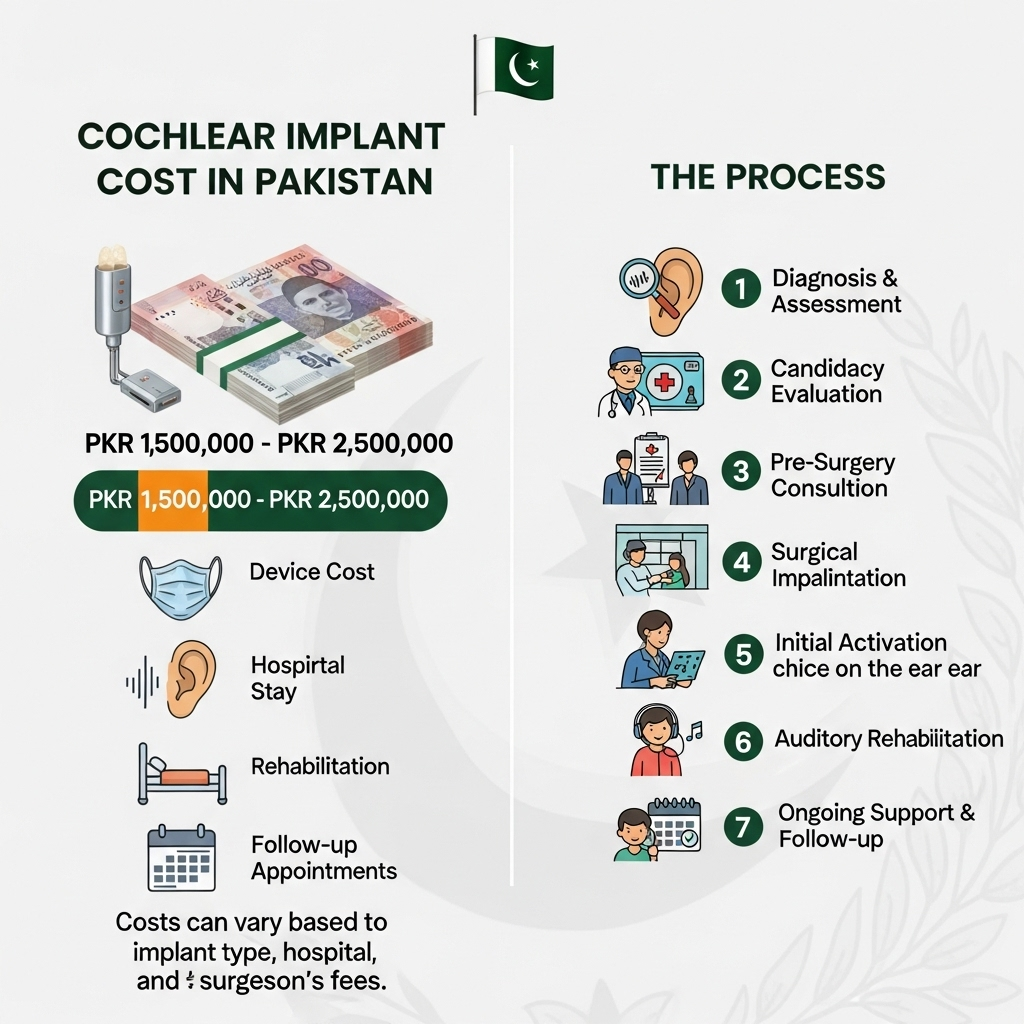
  • PKR 1.8 million to PKR 3 million (approximate range for device + surgery + rehabilitation).
  • This includes the implant itself, surgical charges, hospital stay, activation, and post-operative therapy.

Factors Affecting Cost

  • Brand of Implant: Leading global brands such as Cochlear, Med-EL, and Advanced Bionics are available in Pakistan, with varying prices.
  • Hospital/Clinic Charges: Large hospitals in Karachi, Lahore, and Islamabad may have higher costs compared to smaller setups.
  • Surgeon’s Expertise: Highly experienced ENT surgeons and audiologists may charge more.
  • Rehabilitation Therapy: Post-surgery speech therapy and regular check-ups add to the long-term cost.

Cost Comparison with Other Countries

  • In the United States, cochlear implants can cost more than USD 30,000 to 50,000, making Pakistan a relatively more affordable option.
  • This is why many families find treatment in Pakistan both accessible and cost-effective.

Also read: 10 Early Signs of Hearing Loss You Should Never Ignore

The Cochlear Implant Process in Pakistan

Understanding the process helps families prepare for this life-changing journey. At Islamabad Hearing Center, we guide patients step by step.

Step 1: Initial Consultation & Hearing Tests

  • Comprehensive ENT examination.
  • Detailed audiological assessments to confirm candidacy.
  • Counseling for patients and families.

Step 2: Pre-surgery Counseling

  • Explaining expectations clearly.
  • Discussion of risks, benefits, and outcomes.
  • Medical clearance through blood tests, imaging, and general health check-ups.

Step 3: The Surgery

  • Cochlear implant surgery is typically performed under general anesthesia.
  • Duration: Around 2–4 hours.
  • Patients usually stay in the hospital for 1–2 days.

Step 4: Activation & Device Fitting

  • About 2–4 weeks after surgery, the external speech processor is fitted.
  • Audiologists program and fine-tune the device for optimal performance.

Step 5: Post-surgery Rehabilitation

  • Speech therapy plays a critical role in adapting to the new way of hearing.
  • Regular follow-up visits are required to adjust programming and monitor progress.
  • Support for parents and family members to reinforce therapy at home.

Also read: Too Weak to Travel, Too Proud to Ask Until Help Came Home

Financial Support & Insurance in Pakistan

The high cost of cochlear implants in Pakistan often raises concerns, but there are support options:

  • Government Programs: Certain government hospitals offer subsidized implants for children.
  • NGOs and Charities: Organizations sometimes sponsor children with profound hearing loss.
  • Installment Plans: Some hospitals and clinics provide flexible payment options to make treatment more affordable.
Choosing the Right Cochlear Implant Center in Pakistan

What to Look For

  • Qualified ENT surgeons and audiologists with implant experience.
  • Access to advanced diagnostic and surgical equipment.
  • On-site speech therapy and rehabilitation facilities.
  • Transparent cost breakdown and aftercare support.
Leading Cities Offering Cochlear Implants
  • Islamabad – Modern centers like Islamabad Hearing Center with expert audiologists and rehabilitation services.
  • Lahore – Renowned teaching hospitals and private clinics.
  • Karachi – Equipped with experienced ENT surgeons and implant programs.
Why Choose Islamabad Hearing Center?

At Islamabad Hearing Center, we pride ourselves on delivering complete hearing solutions, from diagnosis to rehabilitation. Here’s why families trust us:

  • Expert Audiologists & ENT Specialists with years of implant experience.
  • Advanced Hearing Tests and candidacy evaluations.
  • Personalized Care Plans for both children and adults.
  • Post-surgery Speech Therapy to ensure successful rehabilitation.
  • Affordable Packages compared to international standards.
Conclusion

A cochlear implant is more than a medical device—it’s a life-changing solution for those struggling with severe hearing loss. In Pakistan, the cost typically ranges between PKR 1.8 to 3 million, depending on brand, hospital, and aftercare needs.

The process includes consultation, surgery, activation, and rehabilitation, with speech therapy playing a critical role in success. Choosing the right center is vital, and Islamabad Hearing Center ensures expert guidance and compassionate care every step of the way.

If you or a loved one is considering a cochlear implant, don’t wait. Book your first appointment with Islamabad Hearing Center today and take the first step toward better hearing and a brighter future.

Categories
Cochlear Implant

Cochlear Implant Price in Pakistan: A Comprehensive Guide to Costs and Benefits

If you or a loved one is considering a cochlear implant in Pakistan, you’re likely wondering about the price and associated costs. This guide aims to clarify the financial aspect while discussing the advantages of cochlear implants over traditional hearing aids.

From understanding the cost to exploring features like cochlear implant battery life, we’ll cover everything you need to know before making this life-changing decision.

Understanding Cochlear Implant Costs:

The price of a cochlear implant in Pakistan can vary significantly based on several factors, including the brand, type of device, surgical fees, hospital charges, and post-implantation rehabilitation costs.

Generally, a cochlear implant is a substantial investment, but its long-term benefits and improved quality of life must be considered. While the initial cost may seem daunting, many individuals find it worthwhile considering the transformative effects on their hearing ability.

Child Cochlear Implant:

Children with severe to profound hearing loss can significantly benefit from cochlear implants, allowing them to develop speech and language skills more effectively.

The child cochlear implant process involves comprehensive evaluation, surgery, activation of the device, and ongoing auditory training and support. While the cochlear implant price in Pakistan for children may be similar to that for adults, the long-term benefits for their development and education make it a worthwhile investment.

Cochlear Implant 3D Model:

Advancements in technology have led to the development of cochlear implant 3D models, which are used for surgical planning and patient education. These detailed models give surgeons a better understanding of the patient’s anatomy, allowing for more precise implantation and minimizing the risk of complications.

While not directly related to the cochlear implant price in Pakistan, 3D models contribute to the procedure’s overall success and safety.

Cochlear Implant Battery Life:

One factor to consider when evaluating the cochlear implant price in Pakistan is the device’s battery life. Modern cochlear implants typically use rechargeable batteries, offering convenience and cost savings over disposable options.

Longer battery life means fewer interruptions in hearing and fewer instances of replacing batteries, enhancing the user experience and reducing ongoing expenses.

Benefits of Cochlear Implants over Hearing Aids:

While hearing aids suit many individuals with hearing loss, cochlear implants offer distinct advantages, particularly for those with severe to profound deafness.

Some benefits of cochlear implants over hearing aids include improved speech understanding, better performance in noisy environments, and the ability to hear a wider range of sounds. Additionally, cochlear implants may be a more viable option for individuals with certain types of hearing loss that cannot be adequately addressed with hearing aids alone.

Conclusion:

Investing in a cochlear implant in Pakistan is a significant decision that can profoundly impact your life or the life of a loved one. While the cochlear implant price in Pakistan may seem daunting, it’s essential to consider this technology’s long-term benefits and improved quality of life.

From children benefiting from early intervention to adults regaining independence and confidence, cochlear implants can transform lives. If you’re considering a cochlear implant, consult a qualified audiologist and surgeon to explore your options and make an informed decision.

Contact us today to speak with a qualified audiologist and surgeon and make an informed decision about your hearing health journey.